02 Catalog line · 1100x1100
1100x1100 plastic pallets
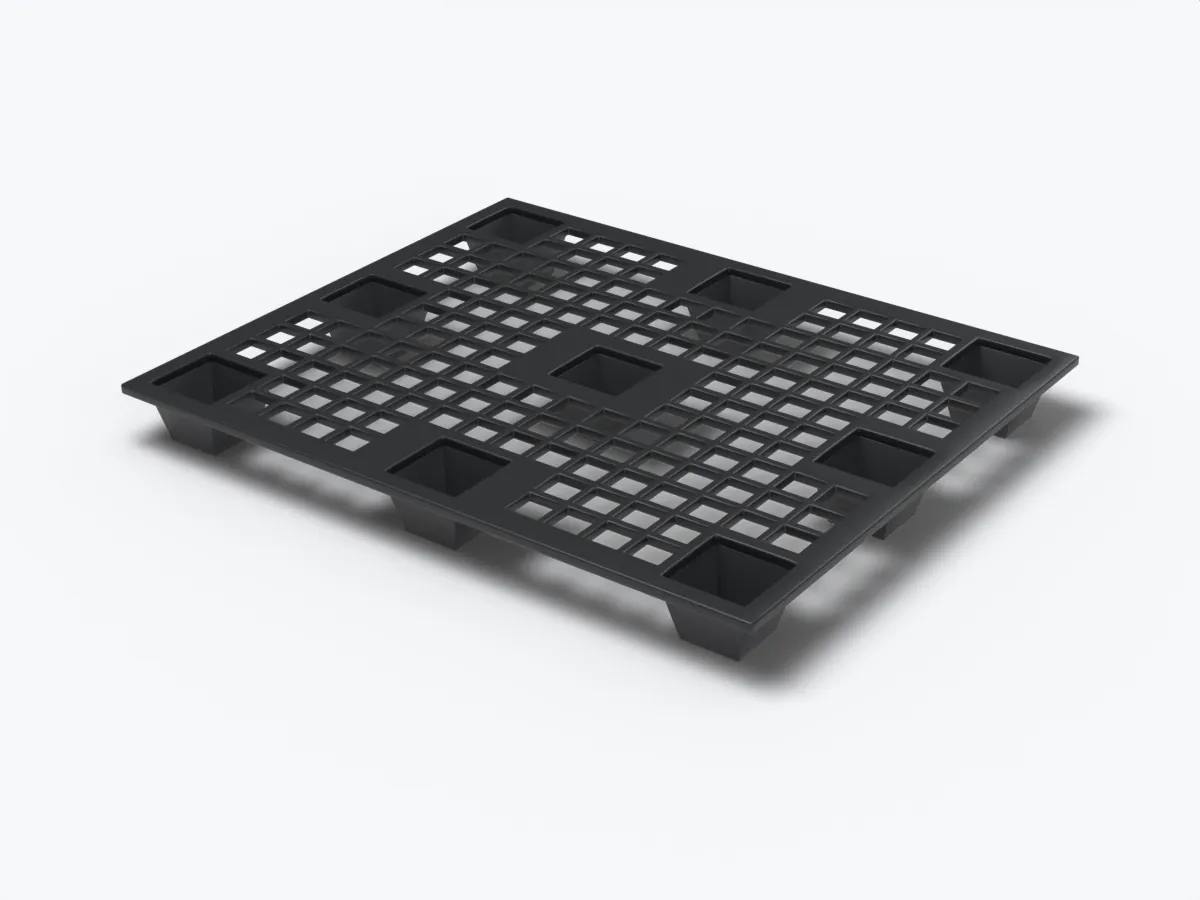
1100x1100 plastic pallets are a square of 1100 mm a side (about 43.3 in), the standard footprint in Japan and Korea and one of the ISO 6780 sizes. We quote one-way and returnable 1100x1100 plastic models for US shippers sending freight to Asia; send the destination, load, quantity and the ZIP where loads are built.
- Dynamic load
- Asian makers often publish in kg; ask for the figure in pounds too
- Static load
- Ask whether the floor figure allows block stacking at the receiver
- Racked load
- Give the receiver's beam spacing and ask for a racked load at it
1100 mm square in both units
The deck is 1100 x 1100 mm, about 43.3 in each way. It sits between the US 42x42 (1067 mm) and 44x44 (1118 mm), close to both but equal to neither, so order it by the metric figure.
Japan's standard pallet, often called the T11, is this size, and Korea uses it as well. It appears in ISO 6780, and it shows up in other Asian supply chains that trade heavily with those two countries.
| Item | Figure | Arithmetic |
|---|---|---|
| Footprint | 1100 x 1100 mm | about 43.3 x 43.3 in |
| 53-ft US van | about 28 | 2 across (86.6 in of 100), 630 / 43.3 = 14.5, so 14 rows |
| 20-ft container | about 10 | 2 across (2200 mm of about 2347), 5883 / 1100 = 5.3, so 5 rows |
| 40-ft container | about 20 | 2 across, 12,040 / 1100 = 10.9, so 10 rows |
| Nearest US sizes | 42x42 and 44x44 | 1067 mm and 1118 mm a side |
A square that suits the container
Two 1100 mm pallets take 2200 mm of a container's roughly 2347 mm interior width, leaving about 147 mm, close to 6 in, for the walls and any overhang. Because the pallet is square, there is no need to mix orientations; every row is the same. A 20-foot box holds 5 rows, about 10 pallets, and a 40-foot box holds 10 rows, about 20.
The margin along the length is generous too. In a 40-foot box, 10 rows use 11,000 mm of about 12,040, so there is room for door clearance and dunnage.
Who in the US buys 1100x1100
US exporters who sell into Japan and Korea, and the forwarders who consolidate their freight. Typical loads include food ingredients, packaged foods, chemicals and resins, auto and electronics parts, and machinery components. Building the shipment on the receiver's footprint means it goes into their racks and automated warehouses without being moved to a new pallet.
Some returnable programs between a US plant and an Asian sister plant also run on this square, using tracked pallets that come back in a container.
West Coast gateways such as Los Angeles, Long Beach, Oakland, Seattle and Tacoma handle much of the container freight bound for Japan and Korea, so many of these loads are built at plants or cross-docks within a truck run of those ports.
| Product | Why plastic | What to ask |
|---|---|---|
| Frozen beef, pork and seafood | Cleanable deck, no moisture uptake | Ratings measured at freezer temperature |
| Feed, grain and pet food in bags | No bark or insects to inspect | Solid deck so bags do not sag |
| Semiconductor and lab equipment | No dust, splinters or nails | Low-static or cleanroom models |
| Bourbon, wine and craft beer | Even height for automated depots | Lipped decks for cases |
| Pulp, paper and lumber products | Dry base, uniform tare | Heavy-duty static rating |
No wood treatment to prove
Wood pallets going into most Asian ports must meet ISPM 15: heat treated or fumigated and stamped with the IPPC mark. Plastic pallets fall outside that standard. USDA APHIS lists plastic pallets among the alternatives to wood packaging material, which its WPM rules do not cover.
That spares the shipper a treatment certificate and the risk of a held container over a missing or smudged stamp. Rules on the goods themselves, and any receiver requirements for the pallet, still apply.
A plastic pallet also avoids the damp and mold that bare wood can pick up during a long ocean crossing, which matters for packaged food and electronics.
Models made in this size
Fewer 1100x1100 models are offered in the US than 48x40 models. Ask for the sheet in the units you work in, and for the test conditions behind each rating.
Japanese and Korean receivers often run automated storage and retrieval systems and conveyor lines built to tight pallet tolerances. Ask the consignee for their pallet spec, including overall height, bottom pattern and allowable deflection, before you choose a model.
- Light nestable one-way pallets that stay with the buyer
- Stackable pallets on runners for floor stacking at the receiver
- Rackable models with a published racked load
- Hygienic one-piece pallets for food and pharmaceutical freight
- Returnable pallets with RFID pockets for tracked loops
In a US trailer
A 53-foot dry van is about 630 x 100 in inside. Two 43.3 in pallets fit across, using 86.6 in, and 630 / 43.3 = 14.5, so 14 rows give about 28 floor positions on the way to the port. That is two fewer than a turned load of 48x40s, which is the price of building loads on the receiver's size at the plant.
Requesting 1100x1100 pallets
Tell us the destination, the load per pallet and its weight, whether the pallets return, whether the receiver racks them, the quantity and the US ZIP where you build loads. We answer by email with models that meet it and a delivered price. Full orders go by 53-foot van, smaller ones LTL.
Questions buyers ask
Which countries use 1100x1100 pallets?
Japan and Korea use it as their standard, and it is common in other Asian supply chains that trade with them.
How many 1100x1100 pallets fit in a 40-foot container?
About 20 one high: 2 across and 10 rows, with room to spare along the length.
Is 1100x1100 the same as 44x44?
No. 1100 mm is about 43.3 in, and a 44x44 is 1118 mm. Order by the exact figure.
Can I send 44x44 pallets to Japan instead?
Only if the receiver accepts them. A 44x44 is 18 mm larger each way than 1100x1100, which can matter in automated storage built for the T11.
Do 1100x1100 pallets come back from Asia?
Usually not; most go one way and stay with the receiver. Returnable programs between sister plants exist, and they usually track pallets with RFID.
Sources
- USDA APHIS: wood packaging material and its alternatives
- Cabka: plastic pallets for export and ISPM 15
Last reviewed November 8, 2026.