01 Catalog line
Plastic pallets in bulk, by the truckload
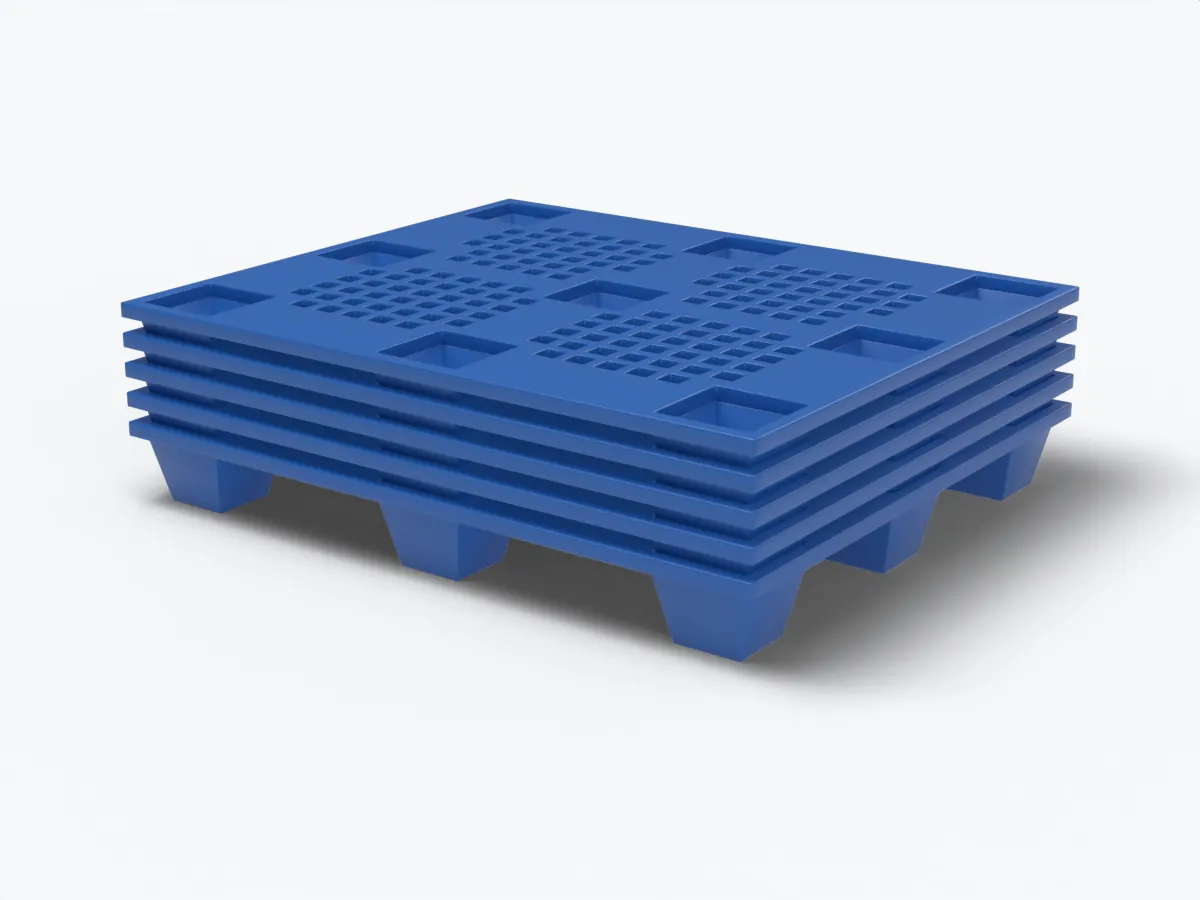
Plastic pallets in bulk ship by the truckload on a 53-foot dry van, or as an LTL order when a full trailer is more than you need. Send the footprint, type, heaviest load, quantity and delivery ZIP, and we'll quote the new models or used loads that fill your trailer, with a delivered price.
- Dynamic load
- Every model on the trailer has its own figure; the quote names it
- Static load
- Ask how high loaded pallets of that model may stack in your building
- Racked load
- Ask per model; a used or mixed load can include unrated pallets
What a truckload of plastic pallets is
A truckload is one 53-foot dry van filled with pallets, standing in stacks on the trailer floor. Inside, that trailer is about 52.5 ft long, about 100 in wide and about 110 in high, and those three numbers set the count. How many pallets fit depends on the footprint, which sets the floor positions, and on how tall each pallet adds to a stack, which sets the pallets per position.
Plastic pallets are light for their size, so a trailer of them usually fills its space long before it reaches the federal 80,000 lb gross weight limit. In freight terms, plastic pallets cube out rather than weigh out. That is why the nest increment of a nestable, or the height of a stackable, matters more to the delivered price than its weight.
The published heavy-duty nestable 40x48 that we use as a reference shows the scale: its maker lists 1,200 pallets per 53-foot trailer, at 28.5 lb each.
Refrigerated trailers and flatbeds are rarely needed. Pallets don't spoil, and a dry van keeps them out of rain and road grime. Intermodal containers on rail can suit very long hauls with flexible timing, but a 40-foot box holds less than a 53-foot van, so the count per unit drops.
Floor positions on a 53-foot van
This table is plain arithmetic on the inside dimensions, before allowing for door clearance, load bars or the shipper's own loading pattern. A real load can come out a position or two different.
| Footprint | Laid | Stacks across about 100 in | Rows along about 630 in | Floor positions |
|---|---|---|---|---|
| 48x40 | 40-in side across | 2 (80 in) | 13 | 26 |
| 48x40 | 48-in side across | 2 (96 in) | 15 | 30 |
| 48x45 | 48-in side across | 2 (96 in) | 14 | 28 |
| 48x48 | Either way | 2 (96 in) | 13 | 26 |
| 42x42 | Either way | 2 (84 in) | 15 | 30 |
| 40x40 | Either way | 2 (80 in) | 15 | 30 |
| 24x40 | 24-in side across | 4 (96 in) | 15 | 60 |
Nested, stacked and racked bases on the trailer
Stacks travel banded or stretch-wrapped into bundles so a forklift can lift each one whole. Ask the quote for the bundle count and the height of a bundle if your dock door, racking or mezzanine sets a limit.
| Base | How the stack builds | Pallets per trailer | Returning empties |
|---|---|---|---|
| Nestable legs | Each pallet adds only its nest increment | Highest | Same density as outbound |
| Stackable runners | Each pallet adds its full height | Lower | Full height each |
| Rackable perimeter base | Each pallet adds its full height | Lowest of the three, and heavier | Full height each |
| Mixed used lot | Uneven stacks of different heights | Varies with the mix | Depends on what you keep |
Full truckload or LTL
Freight is a large part of what a plastic pallet costs delivered, so the per-pallet price drops most when the order fills the trailer. A buyer who needs three quarters of a load is often better off rounding up, and the quote can show both.
| Full truckload | LTL | |
|---|---|---|
| Quantity | A full 53-foot van of one model, grade or a planned mix | From a few bundles up to part of a trailer |
| How it travels | Direct from origin to your dock | Through carrier terminals with other freight |
| Handling | Loaded once, unloaded once | Handled at each terminal |
| Delivery price per pallet | Lowest, because freight spreads over the whole load | Higher per pallet |
| No dock at the site | Needs a forklift that unloads from the ground | A liftgate truck can often be arranged |
New production runs and used loads
New pallets in bulk come from the maker's molding schedule. A standard model in a standard color ships from what the maker has already molded or from the next run. Custom colors, hot-stamped logos, RFID tags or a resin change add setup to the run, and custom colors usually carry a minimum quantity. Timing depends on the maker's schedule at the time you order, so the quote states it rather than this page.
Used plastic pallets in bulk are one-off loads. A trailer of Grade A or Grade B of one model is sold as it is, and when it's gone the next load may be a different model. Mixed lots ship by the load, sorted only by footprint.
Repeat buyers set up a program: the same model, a planned number of loads, and delivery to one or more sites. Resellers and distributors buying wholesale use the same route. Distributors who resell usually want the same model across repeat loads, so their own customers get an identical part each time; name that requirement and the quote will favor models in regular production.
Receiving a truckload
A dock with a leveler and a forklift is the simplest case: bundles come off one at a time and go straight to storage. Floor-loaded trailers need a forklift or a powered pallet jack that can reach to the nose of the trailer. If the site has no dock, has height or length limits for the truck, or receives only at set hours, say so on the request, because it changes which carrier and equipment the quote uses. Appointment windows, weekend or after-hours receiving and lumper fees at large DCs all shape the freight cost, so mention any that apply.
Storage is the part buyers forget. A full trailer of non-nesting pallets covers a sizable stretch of floor once unloaded, while the same count of nestables fits in a corner. Measure where the bundles will go before the truck arrives, and decide whether stacks may stand outdoors under cover or must come inside.
Count bundles against the bill of lading before the driver leaves, and note any crushed or broken bundle on it.
What to put in a bulk quote request
We reply by email with the models or used loads that meet the load, the count per trailer for each, and a delivered price per pallet and per load.
- Footprint and type, or the job the pallets do
- Deck, and the heaviest load per pallet, racked or not
- Quantity in pallets or in trailers, and whether it repeats
- New, used grade or either
- Color, logo or RFID, if any
- Delivery ZIP or ZIPs, and the receiving setup at each
Questions buyers ask
How many plastic pallets are in a truckload?
It depends on the footprint and on how much height each pallet adds to a stack. One published heavy-duty nestable 40x48 fits 1,200 to a 53-foot trailer; non-nesting models fit far fewer.
Is it cheaper to buy plastic pallets by the truckload?
Usually, per pallet. Freight is a large share of the delivered price, and a full trailer spreads it across the most pallets.
Can one truckload hold more than one pallet model?
It can when the models ship from the same origin and the load is planned that way. Say which mix you need on the request.
Can you ship less than a truckload?
Yes. Smaller orders ship LTL, which costs more per pallet but avoids buying more than you need.
Sources
- Cabka: plastic pallets for export and ISPM 15
- Rehrig Pacific: 40 x 48 heavy duty nestable pallet sheet
Last reviewed November 8, 2026.