02 Catalog section
Plastic pallet sizes and footprints
Plastic pallets come in a set of standard footprints: 48x40 for US grocery, 48x48 for drums, 48x45 for auto parts, 40x40 for dairy, and the ISO sizes such as 1200x800 for export. Pick your footprint below, then send it with your type, deck, heaviest load, quantity and delivery ZIP for a quote.
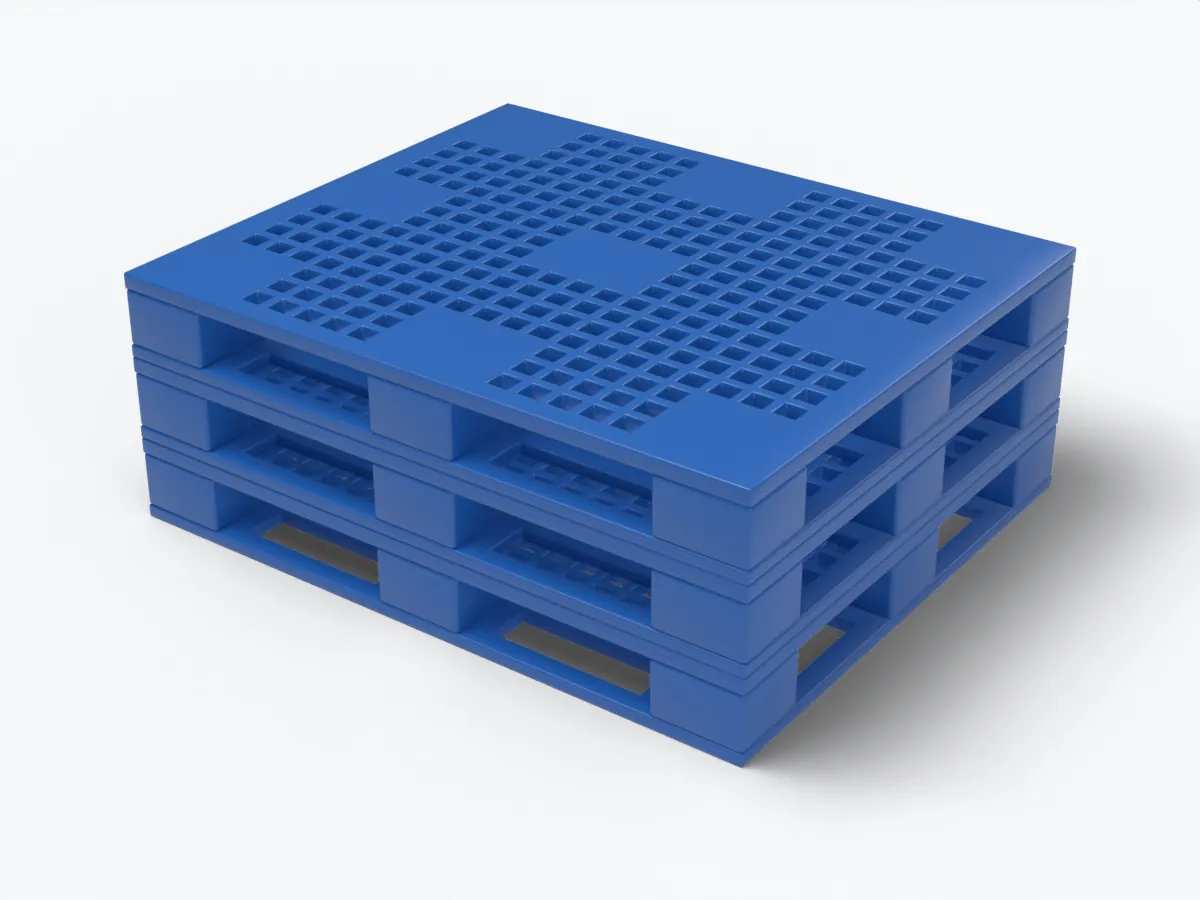
- Dynamic load
- Set by the model, not the size; every footprint spans light to heavy
- Static load
- Floor-stack ratings vary within one size; read the exact model's sheet
- Racked load
- Only rack-rated models in a size carry a racked load; ask for it
In this section
- 02.01 48x40 plastic pallets48x40 plastic pallets, the GMA grocery footprint: nestable, rackable and food-grade models, how 40x48 is read, and trailer counts per model.
- 02.02 48x48 plastic pallets48x48 plastic pallets carry four 55-gallon drums or a square bulk container. Solid and open-deck models, rated loads and where 48x48 is the standard.
- 02.03 48x45 plastic pallets48x45 plastic pallets (1219 x 1143 mm), the automotive parts footprint: rackable and sleeve-pack bases, and how they fit a 53-ft van or container.
- 02.04 42x42 plastic pallets42x42 plastic pallets (1067 x 1067 mm) for telecom gear, paint and coatings: types in this square, container fit and how to get a quote.
- 02.05 40x40 plastic pallets40x40 plastic pallets (1016 x 1016 mm), the dairy footprint: open-deck HDPE for coolers and washdown, plus trailer and container counts.
- 02.06 48x42 plastic pallets48x42 plastic pallets (1219 x 1067 mm) for chemical and beverage shippers: models in this footprint and how many fit a van or container.
- 02.07 44x44 plastic pallets44x44 plastic pallets (1118 x 1118 mm) for drums and chemicals: drum fit and overhang, model types, and two-across container loading.
- 02.08 48x36 plastic pallets48x36 plastic pallets (1219 x 914 mm) for beverage, roofing shingles and packaged paper: types, and the turned load that fits about 34 per van.
- 02.09 36x36 plastic pallets36x36 plastic pallets (914 x 914 mm), a small square used in beverage: types, tight-space uses, and counts for a van and a container.
- 02.10 1200x1000 plastic pallets1200x1000 plastic pallets (47.2 x 39.4 in), the ISO industrial footprint for Europe, the UK and Asia: types, export use and container counts.
- 02.11 1200x800 Euro plastic pallets1200x800 Euro plastic pallets (47.2 x 31.5 in) for European retail and freight: types, ISPM 15 status, and counts for a van and a container.
- 02.12 1100x1100 plastic pallets1100x1100 plastic pallets (43.3 x 43.3 in), the Asian square used in Japan and Korea: types, export rules and two-across container fit.
- 02.13 24x40 Half plastic pallets24x40 half plastic pallets (610 x 1016 mm) for retail floor displays: how two pair up on a 48x40 spot, display types and trailer counts.
- 02.14 20x24 Quarter plastic pallets20x24 quarter plastic pallets (508 x 610 mm) for small retail displays: four to a 48x40 spot, dolly use, display types and trailer counts.
What a footprint tells you
A footprint is a pallet's length by width in inches, measured across the deck. It says nothing about height, weight or rated load. Two 48x40 pallets can share an outline and still differ by thousands of pounds of racked capacity, so the footprint is where a search starts, not where it ends.
Nominal sizes are rounded. A maker's drawing gives the overall size, which is often a fraction of an inch larger than the name. One published heavy-duty nestable sold as a 40x48 measures 48.25 x 40.25 x 6.5 in. That quarter inch matters when you count pallets across a trailer or a container, and when a rack, a conveyor or a stretch-wrap turntable was set up for an exact dimension.
How US pallet sizes are read
US sizes are written length first, then width. Length is the stringer direction on a wood pallet, and on a plastic pallet it is the direction the runners or bottom skids run. A 48x40 is 48 in long and 40 in wide, with its runners running the 48 in way.
Flip the numbers and you describe a different pallet. A 40x48 has the same outline, but its runners run the 40 in way. On a two-way pallet the forks enter the ends, the faces that show the width, so a 48x40 takes forks on its 40 in sides. Most plastic pallets are four-way entry, which takes forks from every side, yet runner direction still decides how the pallet rides a chain conveyor and which way it should sit on rack beams.
Metric sizes from ISO 6780 are written in millimetres. A 1200x800 Euro pallet is about 47.2 x 31.5 in. When you order a metric footprint, give the millimetre figure; rounding it to inches can land you on a different mold.
Every footprint in the catalog
Each size below has its own page with the industries behind it, the pallet types molded in it, and a fit count for a 53-foot van and a 20- or 40-foot container.
| Size | Inches (L x W) | Millimetres | Main users | Region |
|---|---|---|---|---|
| 48x40 | 48 x 40 | 1219 x 1016 | Grocery and consumer goods (the GMA pallet), general distribution | North America |
| 48x48 | 48 x 48 | 1219 x 1219 | 55-gallon drums, square totes and bulk containers | North America |
| 48x45 | 48 x 45 | 1219 x 1143 | Automotive parts and returnable racks | North America |
| 42x42 | 42 x 42 | 1067 x 1067 | Telecom equipment, paint and coatings | North America; also an ISO 6780 size |
| 40x40 | 40 x 40 | 1016 x 1016 | Dairy plants and milk distribution | North America |
| 48x42 | 48 x 42 | 1219 x 1067 | Chemicals and beverage | North America |
| 44x44 | 44 x 44 | 1118 x 1118 | Drums and chemicals | North America |
| 48x36 | 48 x 36 | 1219 x 914 | Beverage, roofing shingles, packaged paper | North America |
| 36x36 | 36 x 36 | 914 x 914 | Beverage | North America |
| 1200x1000 | 47.2 x 39.4 | 1200 x 1000 | Industrial and export freight | Europe, UK and Asia |
| 1200x800 | 47.2 x 31.5 | 1200 x 800 | The Euro pallet for European retail and freight | Europe |
| 1100x1100 | 43.3 x 43.3 | 1100 x 1100 | Shipments to and from Japan and Korea | Asia |
| 24x40 | 24 x 40 | 610 x 1016 | Half pallets for retail floor displays | North America |
| 20x24 | 20 x 24 | 508 x 610 | Quarter pallets for small retail displays | North America |
Why industries settled on different sizes
Footprints follow the load. A 55-gallon drum is about 23 in across, so four drums set two by two need a square of about 46 to 48 in, which is why drum users run 48x48 or 44x44. Dairy settled on 40x40, a square that suits stacked milk crates. Automotive suppliers use 48x45, and many returnable parts containers are built to it.
Grocery is the reason 48x40 dominates the US. Retailers and their suppliers agreed on one footprint so a pallet could travel from plant to distribution center to store shelf without being restacked. Most other US sizes exist because a product did not fit a 48x40 well: roofing shingle bundles and paper reams on 48x36, beverage cases on 36x36 and 48x42, telecom cabinets and paint on 42x42.
Outside North America the footprints change. Europe runs on the 1200x800 Euro pallet and the 1200x1000 industrial pallet. Japan and Korea use 1100x1100. Australia uses 1165x1165. An exporter usually picks the receiving country's size or the one that loads the container best, since there is no single export footprint.
Floor positions in a trailer and a container
These counts are single-stacked floor positions worked out from interior sizes of about 630 x 100 in for a 53-foot dry van, 231.6 x 92.4 in for a 20-foot container and 474 x 92.4 in for a 40-foot container. Each size page shows the arithmetic. Real loads can come in lower once door clearance, oversize pallets and overhanging product are counted, and empty pallets ship stacked many high, so an empties load is counted differently.
| Size | 53-ft van | 20-ft container | 40-ft container |
|---|---|---|---|
| 48x40 | about 30 turned, 26 straight | about 9 | about 20 |
| 48x48 | about 26 | about 4 (one across) | about 9 (one across) |
| 48x45 | about 28 | about 8 | about 18 |
| 42x42 | about 30 | about 10 | about 22 |
| 40x40 | about 30 | about 10 | about 22 |
| 48x42 | about 30 | about 9 | about 20 |
| 44x44 | about 28 | about 10 | about 20 |
| 48x36 | about 34 | about 10 | about 22 |
| 36x36 | about 34 | about 12 | about 26 |
| 1200x1000 | about 30 to 32 | about 9 | about 20 to 22 |
| 1200x800 | about 39 | about 11 | about 23 to 25 |
| 1100x1100 | about 28 | about 10 | about 20 |
Which pallet types come in which sizes
48x40 has the deepest catalog: nestable, stackable, rackable, food grade, RFID and export models, new and used. The other North American sizes have fewer models each, and they lean toward the job behind the size, such as drum pallets with a raised lip in 48x48 and 44x44, or open-deck stackables in 40x40 for dairy washdown. Metric sizes are mostly stackable and rackable models made for export lanes and European or Asian receivers.
Used supply follows the same pattern. Used 48x40 pallets come off grocery and consumer-goods fleets in volume. Used pallets in less common sizes turn up in smaller lots, and a mixed lot is sorted by footprint before it is sold.
Asking for a quote by footprint
Start the quote form with the footprint and, for a US size, which way the runners should run. Add the pallet type, the deck you need (solid, open grid or lipped), your heaviest load and whether it will sit in a rack, the quantity and the delivery ZIP. We answer by email with the models or used grades that meet it and a delivered price. A full order ships on a 53-foot van; a smaller one ships LTL.
Questions buyers ask
What is the most common plastic pallet size in the US?
48x40, the grocery footprint, which is 48 in long and 40 in wide. It has more plastic models and more used supply than any other size.
Is a 48x40 pallet the same as a 40x48?
The outline is the same. The difference is runner direction: on a 48x40 the runners run the 48 in way, on a 40x48 they run the 40 in way, which matters for conveyors and racks.
Which size should I use for export?
There is no single export size. Match the receiving country's standard pallet, such as 1200x800 for much of Europe or 1100x1100 for Japan and Korea, or pick the footprint that fills your container floor best.
Does the footprint tell me the load rating?
No. Ratings belong to the model, and one footprint is molded in light nestables and heavy rackables alike. Read the maker's sheet for the exact model you are buying.
Sources
Last reviewed November 8, 2026.