01 Catalog line
Nestable plastic pallets
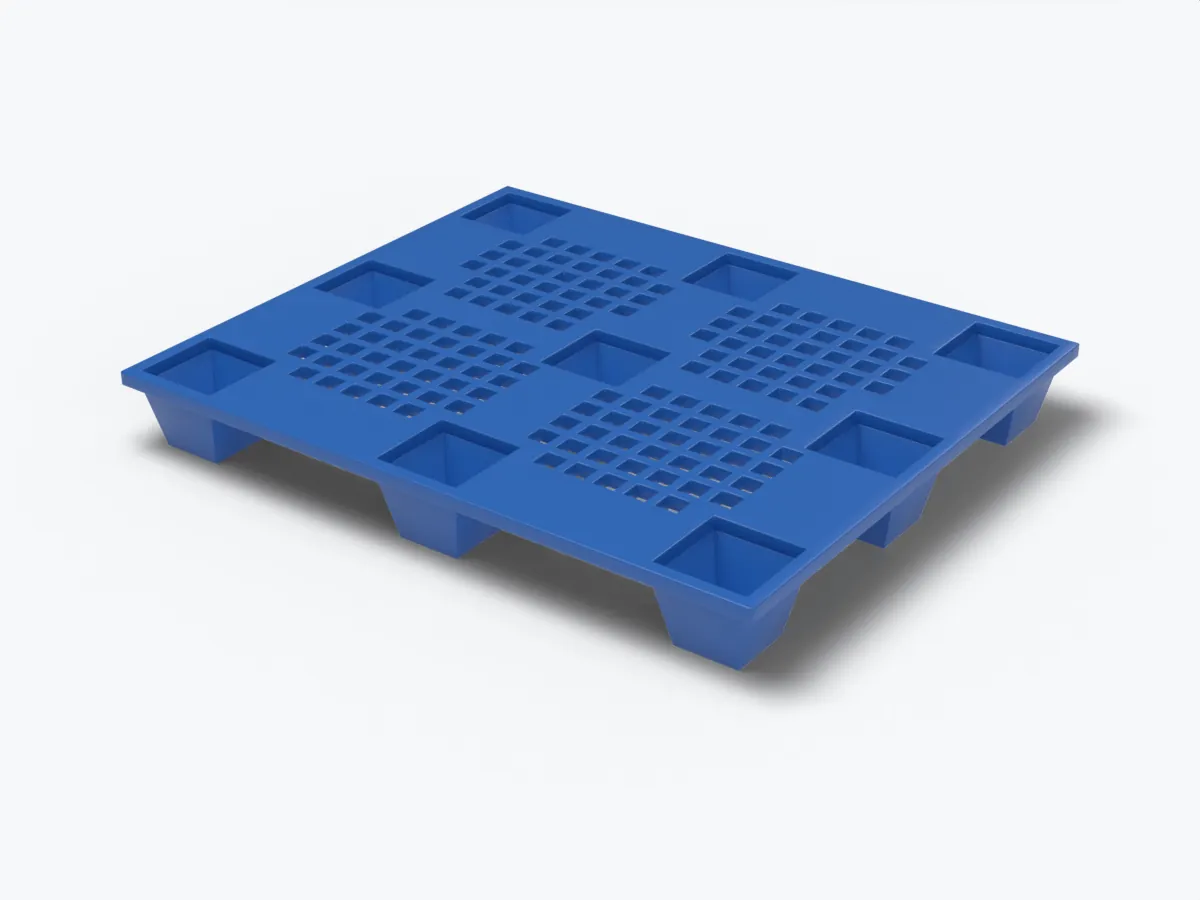
Nestable plastic pallets stand on hollow, tapered legs instead of bottom boards, so an empty pallet drops into the one beneath it and a stack of empties takes a fraction of the height. Send your footprint, heaviest load and delivery ZIP, and we'll quote the nestable models whose published ratings carry it.
- Dynamic load
- Usually published; ask for the figure on forks and on a hand jack
- Static load
- Rated flat on the floor; ask if loaded stacking on legs is allowed
- Racked load
- Most nestables aren't rated; ask for a racked figure before racking
How a nestable pallet is built
A nestable is a deck on legs and nothing else. Most models have nine legs in a three-by-three grid, one at each corner, one at the middle of each edge and one under the center. Each leg is a hollow, tapered cup, so the legs of the pallet above slide down inside the legs of the pallet below.
There are no runners or bottom deck boards. That gives full four-way entry: forks can come in from any side, and a hand pallet jack can roll its wheels down any channel between the legs. It also means the load reaches the floor through nine small feet, which shapes what a nestable can and can't carry.
The deck is open grid on light models, solid on models meant for bagged or boxed goods that would sag into a grid, and sometimes rimmed with a low lip to keep cases from walking off. Most nestables are injection molded in HDPE or PP copolymer, which keeps the leg walls thin enough to nest while the ribbing under the deck carries the load. A few light export models are thermoformed.
The nest increment, and why it sells the type
The nest increment is the height each extra pallet adds to an empty stack once its legs have dropped into the pallet below. It is always much less than the pallet's own height, and it is the number that decides how many empties ride back on one trailer. Makers publish it on the drawing or as a count per stack height.
The published heavy-duty nestable 40x48 we use as an example (Rehrig Pacific, PP copolymer) is 48.25 x 40.25 x 6.5 in and weighs 28.5 lb. Its maker states that 1,200 of them fit on a 53-foot trailer. A non-nesting pallet of the same footprint can't come close to that count, because each one keeps its full height in the stack.
| Field | Value |
|---|---|
| Footprint | 48.25 x 40.25 in (a 40x48) |
| Height | 6.5 in |
| Weight | 28.5 lb |
| Resin | PP copolymer, injection molded |
| Static load | 10,000 lb |
| Dynamic load | 3,500 lb |
| Per 53-foot trailer | 1,200 pallets |
| Options | RFID, colors, hot-stamped logos |
Where nestables fit
In all of these, the saving is in the trip back and the storage between uses. A nested stack can sit in a corner of the dock that would hold only a few non-nesting pallets of the same count.
- Returnable loops where empties go back to the shipper, such as plant to store or supplier to assembly line
- One-way export, where a light pallet saves freight weight and plastic needs no ISPM 15 treatment
- Floor-loaded goods in distribution centers and backrooms that never go into a rack
- Store-door delivery where a jack has to enter from whichever side faces the aisle
- Sites that are short of space for empty pallets between loads
Where nestables don't fit
Racking is the main limit. With no runners, the legs would sit on the beams with the deck spanning the gap on its own ribbing, and most nestables have no racked rating for that. A handful of reinforced models do publish a racked load, so check the sheet rather than assume either way.
Loaded stacking is the second limit. Nine feet put concentrated pressure on the deck or cartons below, so many makers rate nestables for no loaded stacking or for a small number of tiers. Roller and chain conveyors are the third: legs can catch where runners would glide. If the pallet has to do any of these jobs, a stackable or rackable line is the safer place to start.
Nested empties are usually banded or stretch-wrapped into bundles so a forklift can lift a whole stack as one unit. Different models rarely nest together cleanly, because the legs of one mold don't match the cups of another, so keep a returnable loop to one model. Under heavy cartons, a light grid deck can sag between the legs; a solid deck or a heavier-ribbed model reduces that deflection.
Nestable spec table
| Feature | Typical nestable | Confirm on the sheet |
|---|---|---|
| Base | 9 hollow tapered legs, no runners | Leg count and leg footprint |
| Entry | Four-way for forks and hand jacks | Jack channel width on your jack |
| Deck | Open grid, solid, or rimmed | Opening size if small cases ride on it |
| Resin | HDPE or PP copolymer | Resin code on the part |
| Process | Injection molded; some thermoformed | Single shot or welded |
| Racked load | Usually none | A racked figure, beam span and orientation |
| Loaded stacking | None or limited tiers | Tiers allowed and at what load |
| Nest increment | Varies by model | Pallets per stack and per trailer |
| Weight | Light export to heavier heavy-duty models | Weight per pallet |
Sizes nestables are molded in
The 48x40 grocery footprint is where most nestable molds are, in weights from light one-way models to the heavy-duty example above. Square 48x48 nestables exist for bulk bags and totes on the floor. The ISO footprints 1200x800 and 1200x1000 are common for export nestables, and the half and quarter display sizes, 24x40 and 20x24, are often nestable because they live on retail floors.
Color follows the job as well: blue and gray are common in grocery loops, black in industrial and recycled-content lines, and a distinctive color helps a shipper spot its own pallets on a customer's dock.
What to put in a nestable quote request
Tell us the footprint and the heaviest load each pallet will carry, and say plainly whether it will ever be racked or stacked loaded. Add the deck you need, the quantity and the delivery ZIP. If the pallets return empty, say how many go back per trip, since that is where the nest increment pays. Options such as RFID pockets, a color or a hot-stamped logo come from the model's option list, so name them up front. We reply by email with the nestable models that meet the load and a delivered price.
Questions buyers ask
Can nestable plastic pallets be racked?
Most can't. Only a nestable with a published racked load should span two beams, and then only at the span and orientation the maker lists.
Can I stack loaded nestable pallets?
Some models allow a limited number of loaded tiers and some allow none. The legs concentrate weight, so check the maker's stacking note for the load you have in mind.
Do nestable pallets work with a hand pallet jack?
Yes. With no bottom boards, a jack can enter from all four sides, but check that the channels between the legs are wide enough for your jack's forks.
How many nestable pallets fit on a trailer?
It depends on the model's height and nest increment. One published heavy-duty 40x48 nestable fits 1,200 to a 53-foot trailer, per its maker.
Are nestable plastic pallets good for export?
They are the usual export choice, because light nestables cut freight weight and plastic needs no ISPM 15 treatment. Check the load against the model's dynamic rating, since the lightest models carry less.
Sources
- USDA APHIS: wood packaging material and its alternatives
- Cabka: plastic pallets for export and ISPM 15
- Rehrig Pacific: 40 x 48 heavy duty nestable pallet sheet
Last reviewed November 8, 2026.