03 Industry · Meat and Poultry
Plastic pallets for meat and Poultry
Meat and poultry plants run plastic pallets under combo bins, boxed beef and pork, and iced poultry, through blast freezers and a nightly high-pressure sanitation shift. Send footprint, deck, heaviest load, freezer use and delivery ZIP through the quote form; we email back matching models with a delivered price.
The loads on a packing floor
Trim and bulk cuts move in combo bins, the large plastic or corrugated totes set on a pallet base and filled from the cut floor. They are some of the heaviest food loads on any pallet, and the weight sits in a tight square in the middle of the deck.
Boxed meat leaves in waxed corrugated cases, stacked in a column pattern and wrapped. Poultry adds wet loads: iced or chilled birds in cases and totes that drip on the way to the dock. Case-ready plants ship trays of retail packs to grocery DCs.
Offal, hides and rendering material move through the plant too, often on separate, color-coded pallets kept away from edible product.
Sanitation night and the kill floor
A meat plant's sanitation crew works the floor every night with hot water at high pressure, foamed chlorinated alkaline cleaners and sanitizers. Wood can't be cleaned to that standard and comes back wet; it is rarely allowed past the dock in an inspected plant.
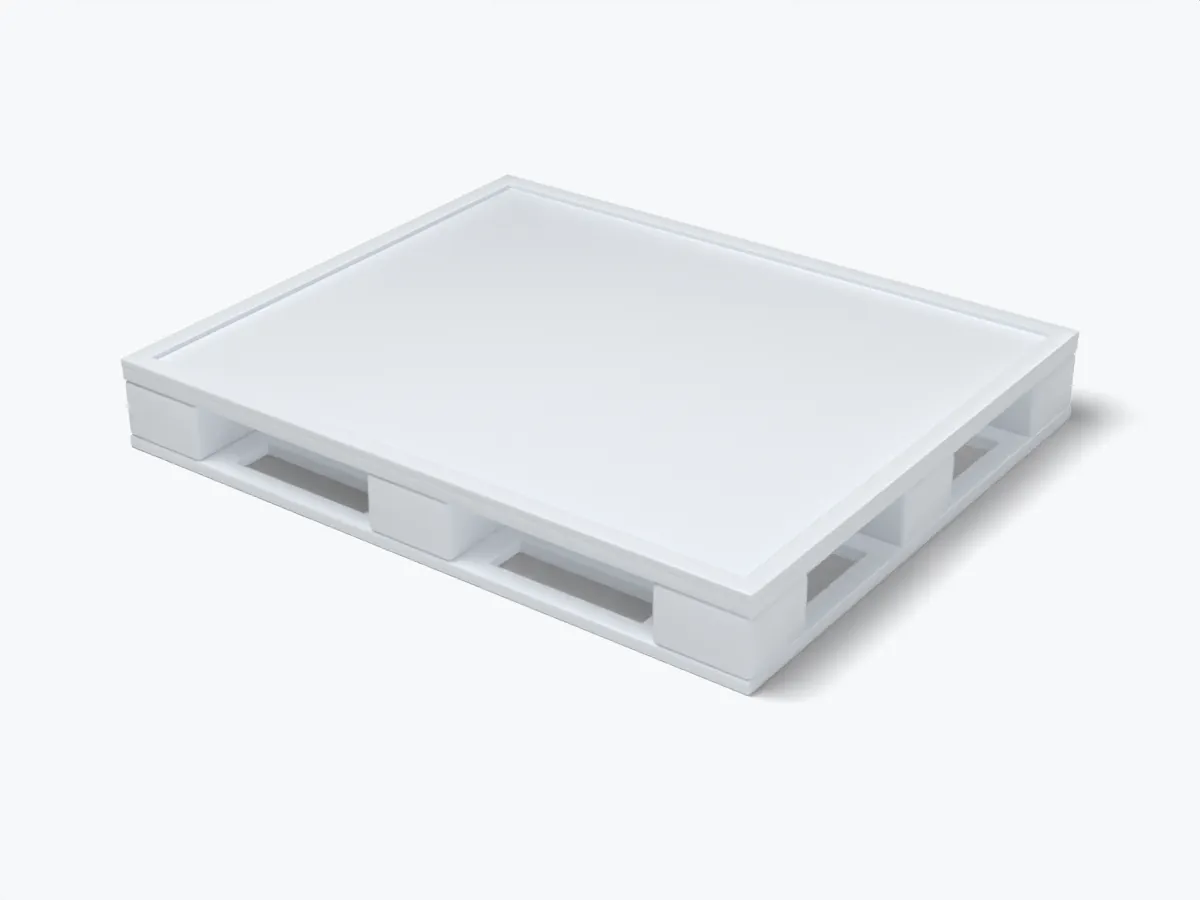
A hygienic plastic pallet for these rooms has a closed or solid deck with rounded corners, no hollow cavities that trap water, and drainage that lets it dry overnight. Open-cell legs and deep ribs hold fat and blood, so read the drawing for where water collects before you approve a model.
Pallets that cross from raw to cooked areas are a cross-contamination point. Plants keep them apart by color and wash or swap pallets at the boundary.
Color also helps with foreign material. Blue is a common choice in edible areas because a chipped corner shows up against red meat and pale poultry, where a gray or black fragment could pass unseen. Retire pallets with broken edges before chips start.
Further-processing lines (sausage, deli, cooked and smoked items) add heat and steam near ovens and cook tanks. Product goes through smokehouses on steel racks or trucks, not pallets, but staging pallets nearby see warm, humid air, which plastic tolerates and wood does not.
Coolers and blast freezers
Carcass coolers and cut rooms run just above freezing; blast freezers and storage freezers run well below zero Fahrenheit. HDPE holds its impact strength at those temperatures. PP copolymer is the other usable resin; plain PP homopolymer cracks when a fork hits it frozen.
Blast freezing goes faster when cold air reaches the bottom cases. An open or vented deck helps; a solid top slows the bottom layer. If a pallet goes into freezer racking, ask the maker for a racked rating at freezer temperature, since most sheets are written for room temperature.
Seafood processors share most of these conditions, plus salt water and slush ice.
Inspection and transport rules
USDA's Food Safety and Inspection Service inspects slaughter and processing plants, and its sanitation requirements cover equipment in edible product areas. FDA's FSMA sanitary transportation rule requires adequately cleanable equipment for food under FDA's jurisdiction. Which rule governs a given lane depends on the product and the facility, so ask your food safety lead; either way, the pallet has to wash clean.
21 CFR 177.1520 governs the olefin resins used in food-contact articles. Ask the maker for its resin letter for the exact model; there is no FDA approval for the finished pallet itself.
Footprints and types for meat and poultry
48x40 is the shipping size for boxed product to retail and food service. Combo bins are built around a square or near-square base, so match the pallet to the bin you run rather than assuming 48x40.
| Job | Footprint | Pallet type | What to ask the maker |
|---|---|---|---|
| Combo bins of trim | Sized to the bin | Heavy duty with runners | Dynamic load with a center-heavy bin |
| Boxed meat to DCs | 48x40 | Food grade rackable | Racked load at cooler temperature |
| Blast freezer cells | 48x40 | HDPE, open deck | Rating and impact at freezer temperature |
| Raw-side staging | 48x40 | Hygienic, solid deck in a zone color | Drainage and closed cavities |
| Inedible and rendering | 48x40 | Stackable in a separate color | Chemical resistance to cleaners |
Quoting a plant fleet
Tell us the footprint or bin size, the deck, the heaviest gross weight, whether it racks in the freezer, the colors per zone, the quantity and the delivery ZIP. We reply by email with models and a delivered price. Fleets that are cracked after years of freezer work still have value as regrind, and we buy them back.
Questions buyers ask
Which deck suits a meat plant?
Closed or solid decks with rounded corners clean best. Use an open deck where blast freezing needs airflow under the bottom cases.
Do plastic pallets work in blast freezers?
HDPE and PP copolymer models do. Ask for the rating at freezer temperature, since most sheets quote room temperature.
Why are so many meat plant pallets blue?
Blue contrasts with meat and poultry, so a chip or fragment is easy to spot on the line. Any color works if your plan assigns it a zone.
Can one pallet handle a full combo bin?
A heavy duty model with runners usually can, but the bin puts its weight in the center. Check the dynamic rating and the deck stiffness on the maker's sheet.
Can pallets go through a tunnel washer?
Most molded models fit automated washers built for pallets, which use hot water, detergent and a sanitizer rinse. Confirm the model's maximum wash temperature with its maker.
Sources
- 21 CFR 177.1520: olefin polymers in food-contact articles
- FDA: FSMA rule on sanitary transportation of human and animal food
Last reviewed November 8, 2026.