01 Catalog line
Grade A used plastic pallets
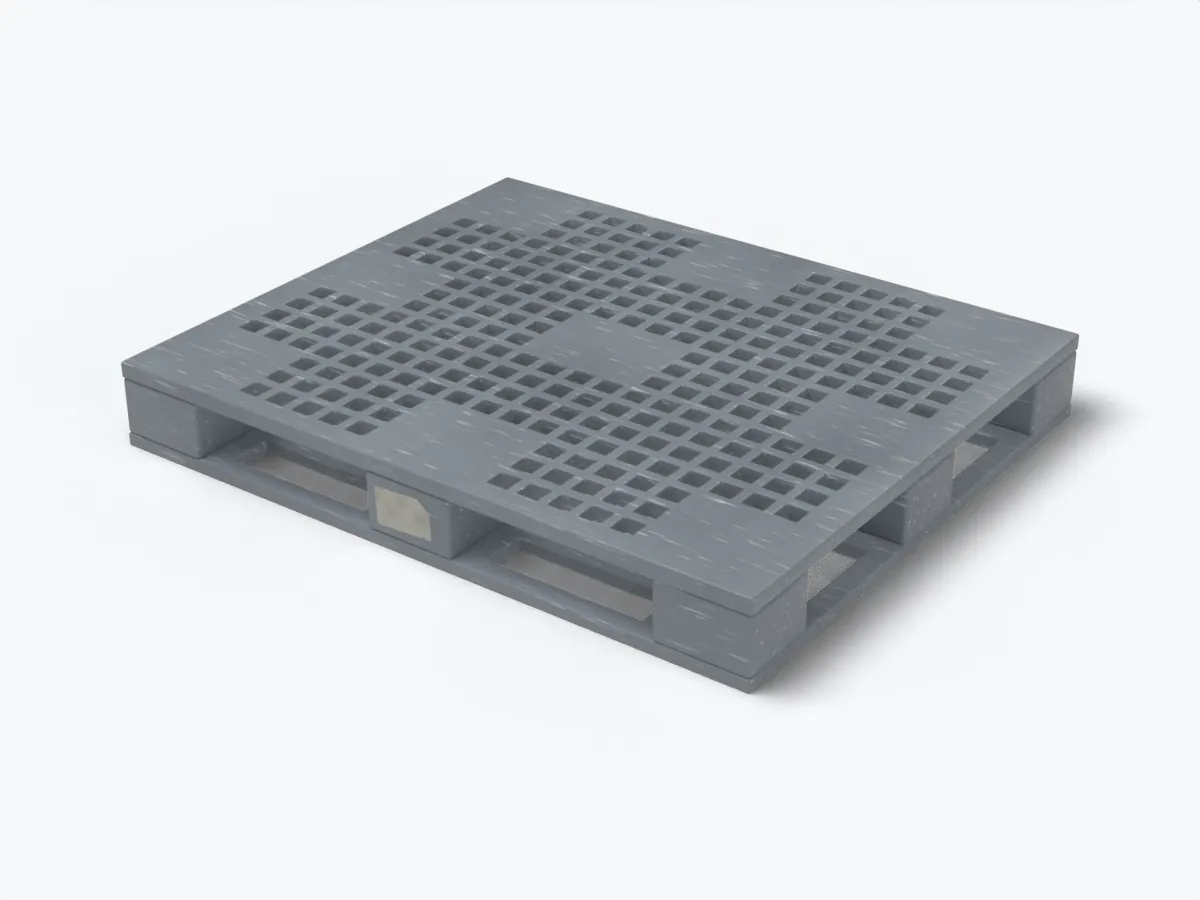
Grade A used plastic pallets are whole: an intact deck, straight legs or runners, no repairs, and clean enough for their next job, rackable only where the original model was rack-rated. Send the footprint, heaviest load, racking plan and delivery ZIP, and we'll quote Grade A loads of a single model that meet it.
- Dynamic load
- The original model's figure is the ceiling; ask for its model number
- Static load
- Same maker's sheet applies; plan the tallest stack with margin
- Racked load
- Only if the original model was rack-rated; check its racked figure
What Grade A means, part by part
Grade A is the top of our three used grades. It describes a pallet that has been in service and shows it only lightly, with nothing broken, missing or mended. A pallet either passes every line below or it isn't Grade A.
| Part | Grade A allows | Drops it to Grade B or lower |
|---|---|---|
| Deck | Whole surface, all ribs present, light handling marks | Gouges, heavy scuffing, a chipped rim |
| Legs, blocks or runners | All present, straight and firmly joined | A split block, a bent runner, a loose leg |
| Reinforcement | Fully covered by plastic | Exposed steel or a cut over an insert |
| Repairs | None | Any weld, plug, screw or replaced part |
| Surface condition | Clean enough for its next use; few or no old labels | Faded color, layers of labels, stubborn residue |
| Markings | Maker, model, resin code and date clock readable | Markings worn away so the model can't be named |
| Flatness | Sits flat on a level floor without rocking | A bowed deck or a rocking base |
Why the markings matter so much
A Grade A pallet is only as useful as what you can prove about it. With the maker's name and model readable on the underside, you can pull the original spec sheet and see the dynamic, static and racked figures it was built to. The resin code tells you whether it is HDPE (2) or polypropylene (5), and the date clock gives the month and year it came out of the mold.
Some makers also mold a part number and a cavity number into the block faces. The cavity number identifies which of several identical molds produced the part, which helps a maker trace a defect back to its source.
That is why Grade A loads are sold as one model at a time. A trailer of identical pallets behaves the same in a rack, on a conveyor and in a stretch-wrap cell, and every one of them answers to the same sheet.
Racking a Grade A pallet
Grade A is the only used grade we describe as rackable, and only on one condition: the original model must have been rack-rated by its maker. A Grade A nestable with no racked figure is still a floor pallet, however good it looks.
Where the model was rated, treat its published racked load as the ceiling and keep your heaviest load well inside it. Use the same beam span and orientation the maker lists. A pallet that has spent years in the sun, in a hot trailer or under constant heavy loads has given up some stiffness, even when it shows no damage, so the margin is there to cover what an inspection can't see.
Freezer racks are harsher still. Cold stiffens plastic and makes it less forgiving of knocks from forklift tines, so a Grade A pallet bound for frozen racking should be an HDPE or PP copolymer model rated for that duty.
Where Grade A is worth paying for
Expect some differences from new even at this grade. Color may be a shade off a new pallet of the same model, and hot-stamped logos, serial numbers or RFID tags from the previous owner can still be on the part.
| Job | Grade A? | The reason |
|---|---|---|
| Topping up a fleet of the same model | Yes | Matches the pallets already in your racks and loops |
| Selective racking | Yes, if the model was rack-rated | Whole runners and a known racked figure |
| Conveyors and automated storage | Yes | Flat, consistent bases of one model |
| Outbound loads your customers see | Yes | Clean decks with few labels |
| Starting a closed loop on a budget | Often | Near-new behavior for less than new |
| Floor storage and internal moves | Usually not needed | Grade B does the same work for less |
| Direct food contact | Not without documents | Prior use and resin paperwork are unknown |
Grade A beside a new pallet
| Point | New | Grade A used |
|---|---|---|
| Ratings | The full published figures | Those figures as a ceiling, with margin for age |
| Color | Uniform from one production run | May differ by a shade across the load |
| Branding | Your logo hot-stamped as an option | The previous owner's marks, if any |
| Supply | Follows the maker's molding schedule | Follows whichever fleets retire |
| Paperwork | Resin letters available from the maker | Rarely transferable from the first buyer |
| Price | Highest | Below new, above Grade B |
Clean enough for its next use
Clean enough means no product residue, grease or caked dirt on the deck, and no strong odor. A pallet retired from a beverage loop can still hold a faint sticky film deep in its ribbing; one from an automotive plant, a trace of oil. Neither suits a sensitive room, so name your setting, such as pharmacy back rooms, bakery dry storage or electronics assembly, and the quote will note what is known of each load's previous service.
Ask whether a load has been pressure-washed, sanitized or simply swept, because those are different things. Washing before use remains sensible for any pallet bought secondhand, whatever its grade.
Ordering Grade A
Grade A loads appear when a fleet of good pallets is retired, so what is on offer changes from month to month. Tell us the footprint, your heaviest load and whether it is racked, the quantity and the delivery ZIP. If you want to match pallets you already run, give the maker and model molded on yours. We reply by email with the Grade A loads that fit, the model and date range of each, and a delivered price, on a full 53-foot van or by LTL.
Questions buyers ask
Are Grade A used plastic pallets rackable?
Only if the original model was rack-rated by its maker. Then use its published racked figure as the ceiling, with margin for age.
Do Grade A pallets have any marks at all?
Light handling marks are normal for a used pallet. Heavy scuffing, faded color or many old labels put a pallet in Grade B.
Can Grade A pallets be mixed models?
No. Grade A loads are one model, so every pallet answers to the same spec sheet.
How old are Grade A used pallets?
Age varies by load. The date clock on each pallet shows its month and year of molding, and the quote gives the load's date range where known.
Sources
Last reviewed November 8, 2026.