01 Catalog line · Stackable
Stackable plastic pallets
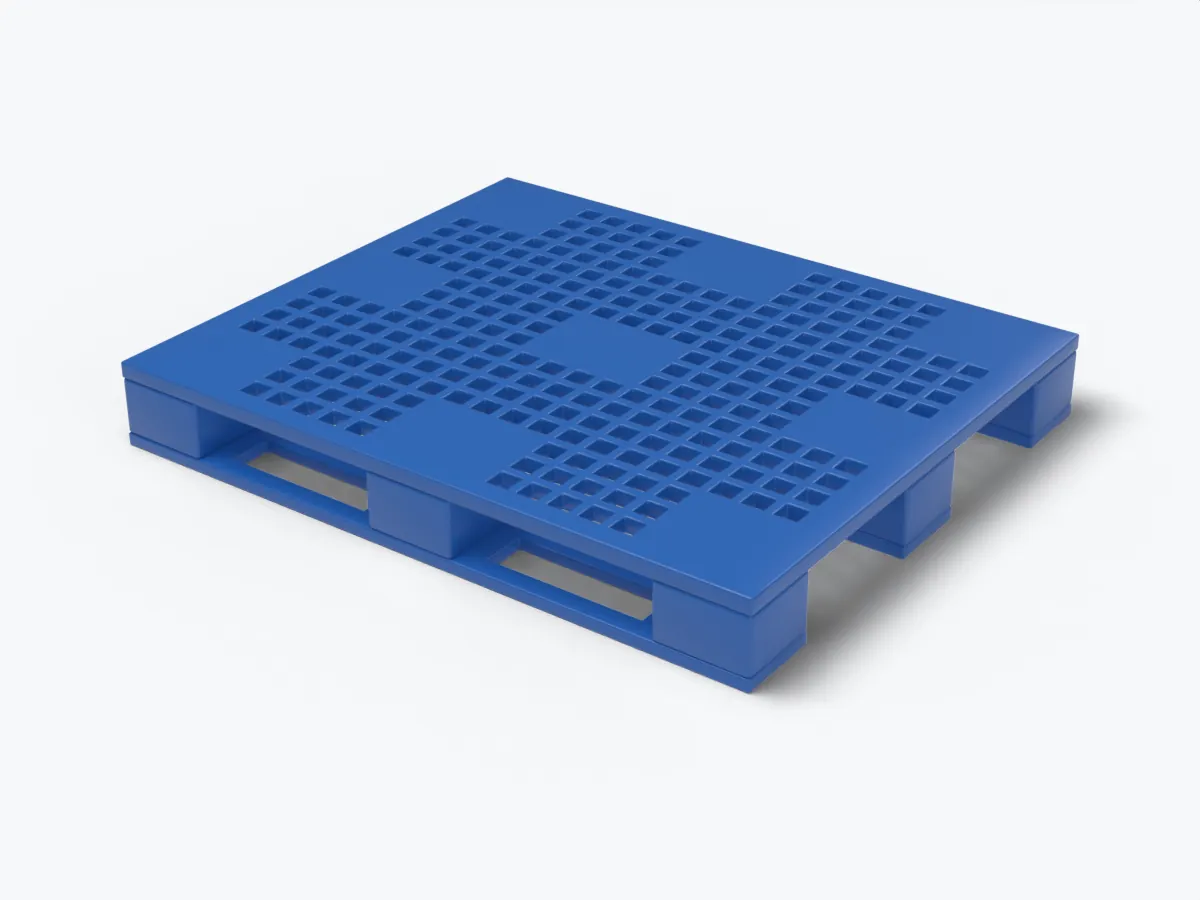
A stackable plastic pallet has a flat deck and a base of runners or a full perimeter, so one loaded pallet can sit on another without crushing the cases below. Send footprint, deck, heaviest load, stack height and delivery ZIP on the quote form, and we email back the models that carry it with a delivered price.
- Dynamic load
- Usually high; ask for the figure with the load spread evenly
- Static load
- The key number: check it against every full load stacked above
- Racked load
- Some are rack-rated, many aren't; get a racked figure before racking
How a stackable pallet is built
The word describes what the base does, not a single design. A stackable has a bottom that spreads its load: three or more runners, or a full perimeter frame, joined to the legs or blocks. When a loaded pallet sits on top of another load, the weight goes down through that base onto a broad area of the cases below, not onto nine small feet.
Most are made in one of three ways. Two-piece pallets have a top deck and a bottom deck molded separately and then hot-plate welded or snapped together into one unit. Structural foam pallets are molded in one shot with a foamed core, giving thick walls and a stiff part. Some lighter stackables are thermoformed from two sheets fused at contact points.
Decks are flat on top: solid for bags and small cartons, or an open grid that drains and saves weight. Many have a raised lip or friction pads to stop slipping. Entry is usually four-way, though some perimeter-base models are effectively two-way for a pallet jack, because the bottom frame blocks the jack wheels on two sides.
Reinforcement and the racked question
A stackable pallet is not automatically rackable. Spanning two beams is a bending load, and a stackable that carries a heavy static stack on the floor may sag badly in a rack. Models made for both jobs add steel tubes or fiberglass rods inside the deck and publish a racked load. Without that figure, keep it on the floor.
Specs of a typical stackable line
Take each rating from the maker's sheet for the exact model; the table shows what to compare.
| Feature | Common options | What it changes |
|---|---|---|
| Base | Three runners, five runners, full perimeter | Stack stability, conveyor fit, jack entry |
| Deck | Solid, open grid, lipped | Drainage, small-carton support, cleaning |
| Construction | Two-piece welded, structural foam, twin-sheet thermoformed | Stiffness, weight, repairability |
| Resin | HDPE (code 2), PP copolymer (code 5) | Cold impact, stiffness, chemical resistance |
| Reinforcement | None, steel tubes, fiberglass rods | Whether a racked load is published |
| Entry | Four-way, two-way for jacks on perimeter bases | Handling in tight aisles |
Jobs it suits and jobs it doesn't
Stackables are the pallet for block stacking: storing full loads two or three high on a warehouse floor with no racks. Beverage cases, bagged ingredients, pails and finished cartons all store this way. The runners also let the pallet travel on chain and roller conveyors, which nine-leg nestables can't do.
They are a poor choice where empty space on the return trip costs money. Stackables don't nest, so a stack of empties takes as much height as the pallets themselves, several times what the same count of nestables needs. For one-way shipping to customers who keep the pallet, a lighter nestable usually costs less.
They also weigh more than nestables of the same footprint, which matters in manual handling and air freight.
Keeping a stack upright
Block-stacked loads lean when the bottom pallet deflects, when cases crush or when the floor slopes. A stiff deck limits deflection, and a lipped edge or rubber friction inserts keep stretch-wrapped units from sliding while a forklift travels.
Column-stacked cases carry more than interlocked ones, so a packaging engineer may change the case pattern before you change the pallet. Carton compression strength, humidity and dwell time often limit stack height as much as the plastic does. Expansion joints and sloped dock floors tilt tall stacks; keep them low there.
Sizes stackables are molded in
48x40 is made by nearly every maker. Stackables also come in 48x45 for automotive loops, 48x48 and 44x44 for drums, 42x42 for paint and coatings, 40x40 for dairy and 1200x1000 for export and European plants. Fewer tools exist in odd sizes, so a rare footprint may mean fewer models to choose from.
Odd footprints such as 36x36 and 48x36 serve beverage, roofing and paper rolls, and 20x24 quarter pallets stack under club-store promotions. Plastic welding repairs exist for some lines, but most damaged stackables go to regrind.
Ordering stackables
On the quote form, give the footprint, deck, the weight of one full pallet, how many high you stack, whether any will go in racks, the quantity and the delivery ZIP. We answer by email with the models that meet it and a delivered price. Grade A and Grade B used stackables are often available too, and suit floor stacking well when the runners are straight.
Questions buyers ask
What is the difference between stackable and rackable?
Stackable means a loaded pallet can sit on top of another load. Rackable means it can span two rack beams; that needs its own published rating.
Can a stackable pallet go on a conveyor?
Usually yes, if its runners lie across the rollers. Check the bottom pattern against your conveyor.
How high can I stack loaded stackable pallets?
As high as the static rating allows for the total weight above the bottom pallet, and as high as the cases themselves can bear.
Are stackable pallets heavier than nestables?
Generally, yes. The runners or perimeter base add plastic, which is what lets them stack loaded.
Which industries block-stack the most?
Beverage, paper converting, roofing shingles, bagged cement, pet food and seed. All run dense, square unit loads that store well on a floor.
Sources
Last reviewed November 8, 2026.