05 Guide
How to read a plastic pallet's load ratings
A plastic pallet carries three published ratings: dynamic load (moving on forks or a jack), static load (sitting flat on the floor) and racked load (spanning two beams with nothing underneath), and the racked figure is usually the lowest. Read all three from the maker's sheet for the exact model, then send us your heaviest load for a quote.
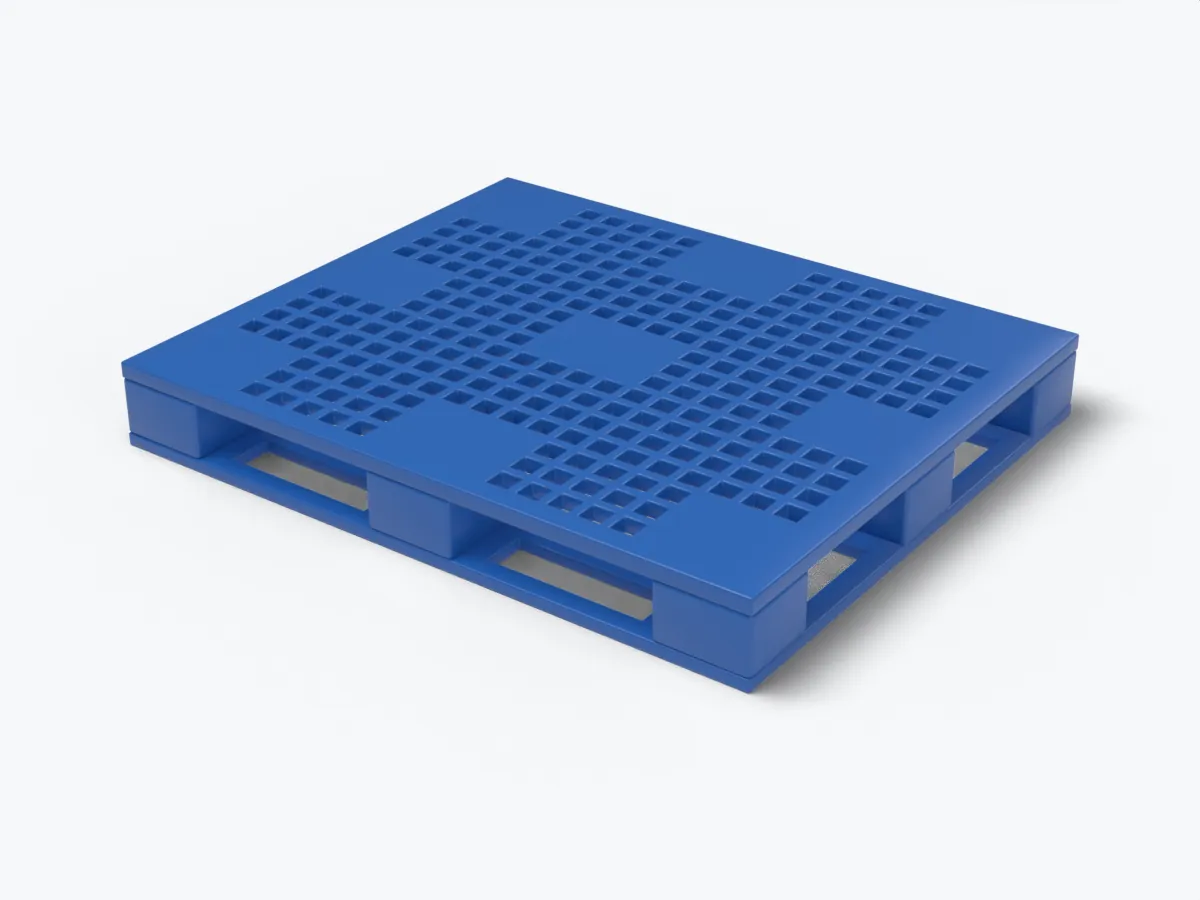
The three numbers on a spec sheet
Every molded pallet model is tested by its maker and listed with up to three capacities in pounds. Each one describes a different support condition, so they are not interchangeable and none of them is a general strength score.
Dynamic load is the weight the pallet can hold while a forklift, reach truck or pallet jack lifts and carries it. The pallet is supported only where the tines or the jack forks touch it, and it is being jolted and tilted on the way.
Static load is the weight the pallet can hold sitting on a flat, hard floor with full support under its legs or runners. This is the number that matters when loaded pallets are block-stacked several high, because the bottom pallet carries everything above it.
Racked load is the weight the pallet can hold while it bridges two rack beams with open air between them. The deck has to act like a beam, so this is the hardest case for a plastic part and normally the smallest figure on the sheet.
| Rating | How the pallet is supported | Where it applies | What to confirm on the sheet |
|---|---|---|---|
| Dynamic | On fork tines or jack forks, in motion | Lifting, carrying, loading trailers | Whether the figure assumes forklift or pallet jack entry |
| Static | Flat on a level floor, fully supported | Floor storage and block stacking | Whether stacked loads above count toward the figure |
| Racked | Across two beams, open span between | Selective pallet rack, push-back, flow lanes | Beam spacing, span direction and edge or full support |
Why the racked load is usually the lowest
On the floor, a pallet's legs or runners push the weight straight down into concrete. On a rack, the middle of the deck hangs between two beams, so the plastic bends. The more open span there is, the more it bends.
Plastic also creeps. Under a sustained load it keeps deflecting slowly over hours and days, which wood and steel do far less. A pallet that looks flat when it goes up on Monday can sag noticeably by the end of the month if the load is above what the model was rated to span.
Makers set the racked rating with creep in mind: it is the weight the deck can hold for long periods without sagging past their deflection limit. That is why a model rated in the thousands of pounds on the floor may carry a much smaller figure, or no figure at all, in a rack.
A blank racked cell on a spec sheet is an answer, not an omission. It means the maker has not rated that model to span beams, and it should stay on the floor.
Span direction, beam spacing and how the load sits
A 48x40 pallet can sit in a rack with its 40-inch side spanning the beams or its 48-inch side spanning them. The longer span is the weaker one, so many sheets state the racked figure for one direction only. Check that the direction on the sheet matches how your racks are set.
The rating also assumes the load is spread evenly over the deck. Drums, coils, engine blocks or a single crate sitting in the middle concentrate the weight on a small area, which a uniformly distributed rating does not cover. Ask the maker for a point-load figure or use a pallet with a solid deck and more ribbing.
Drive-in and drive-through racks hold a pallet only by its two edges on rails, with nothing under the middle. That is harsher than selective rack with front and back beams, and some sheets give a separate edge-racked figure for it.
Temperature moves all three numbers. Ratings are usually measured at room temperature; a hot dock or a freezer can change how the resin behaves, so ask for figures at your operating range if the pallets will live in a cooler, freezer or a summer trailer.
- Which side spans the beams, 40 in or 48 in
- Beam-to-beam distance the test used
- Evenly spread load or a point load
- Selective rack, drive-in rails or flow lanes
- Temperature range the rating covers
One published example, read line by line
Rehrig Pacific publishes a heavy-duty nestable 40x48 pallet in PP copolymer, injection molded, measuring 48.25 x 40.25 x 6.5 in and weighing 28.5 lb. Its sheet gives 10,000 lb static and 3,500 lb dynamic.
Read those two numbers in order. A fully supported pallet on a level floor can sit under 10,000 lb, which covers loads stacked on top, and a forklift can carry 3,500 lb on it. The gap between them is the normal pattern: moving a load is harder on the pallet than parking it.
No racked figure appears in those published numbers. A nestable has legs rather than runners, so it has nothing continuous to rest on two beams. That model belongs on the floor, on a truck and in a return stack, not across a rack opening.
| Item | Published value |
|---|---|
| Resin | PP copolymer |
| Process | Injection molded |
| Dimensions | 48.25 x 40.25 x 6.5 in |
| Weight | 28.5 lb |
| Static load | 10,000 lb |
| Dynamic load | 3,500 lb |
| Racked load | Not given |
| Per 53-foot trailer | 1,200 nested |
Matching a rating to your heaviest load
Start from the heaviest single unit load you will put on one pallet, including the packaging, not the average. Then name where that load spends its time: on the floor, stacked, in a rack, or moving between docks.
Pick the rating that matches the worst of those conditions. A load that is racked even once a day needs a racked figure above its weight. A load that is only stacked three high needs a static figure that covers the three loads above the bottom one plus its own.
Leave headroom. Forklift drivers set loads down hard, loads shift in transit, and used pallets have already spent part of their life under weight. Choosing a model whose rating sits comfortably above your heaviest load is cheaper than replacing a sagged rack row.
Used pallets inherit the ratings of their model, not a new set. A used pallet can only be racked if its model was rack-rated new, and our Grade A is the only used grade we offer for racking, on that condition.
What to send us for a quote
Send the footprint, the pallet type, the deck you need, the heaviest load and whether it will be racked, the quantity and your delivery ZIP through the quote form or to info@plasticpalletsforsale.com. We reply by email with the models or used grades whose published ratings meet that load, and a delivered price.
If you have a rack placard or a drawing with beam spacing, include the beam-to-beam distance and the span direction. It lets us check the racked figure against the way your rack is built, not against a generic test setup.
Questions buyers ask
Which load rating matters most for pallet racking?
The racked load. Static and dynamic figures do not tell you how the deck behaves spanning two beams, and plastic creeps under sustained weight, so only a published racked figure answers that.
Why is a pallet's static load so much higher than its dynamic load?
On the floor the legs or runners transfer the weight straight into the concrete. On forks the pallet is held at two strips and jolted as it moves, which is a harder test.
Can I rack a pallet whose sheet shows no racked load?
No. A blank racked cell means the maker has not rated that model to span beams. Keep it on the floor or choose a rack-rated model.
Do used pallets keep their original ratings?
They keep the ratings of their model, which is why we read the maker and model from the part. Racking a used pallet only makes sense when that model was rack-rated.
Sources
Last reviewed November 8, 2026.