05 Guide
How many plastic pallets fit on a trailer
A 53-foot dry van has about 30 floor positions for 48x40 pallets turned, or 26 loaded straight; how many empty pallets fit depends on each model's height or nest step. One published heavy-duty nestable 40x48 ships 1,200 to a trailer. Counts are per model, so send us yours for a delivered truckload quote.
Start with the trailer's inside dimensions
Every trailer count is arithmetic on three numbers: the inside length, the inside width and the inside height. A 53-foot dry van is about 52.5 ft long inside, which is about 630 in, about 100 in wide between the walls and about 110 in high under the roof.
Those figures vary a little by trailer build, liner and door frame, so treat them as working numbers and leave a few inches of slack. The carrier's equipment sheet has the exact inside dimensions if a load is tight.
| Equipment | Inside length | Inside width | Inside height |
|---|---|---|---|
| 53-foot dry van | About 52.5 ft (630 in) | About 100 in | About 110 in |
| 40-foot container | About 39.5 ft (474 in) | About 7.7 ft (92 in) | Check with the forwarder |
| 20-foot container | About 19.3 ft (232 in) | About 7.7 ft (92 in) | Check with the forwarder |
Floor positions by footprint
Floor positions come first. Divide the inside length by the pallet side that runs along the trailer, round down, and multiply by how many fit across the width.
A 48x40 pallet turned with its 40-in side along the trailer and its 48-in side across fits two abreast in 96 in of the 100-in width. That gives 630 divided by 40, which is 15.75, so 15 rows of two: 30 positions. Loaded straight, with the 48-in side along the trailer and 80 in across, it is 630 divided by 48, 13 rows of two: 26 positions.
Square footprints have one answer. Two 48x48 pallets take 96 in across, so 13 rows make 26 positions. Two 42x42 pallets take 84 in, and 15 rows make 30. Two 40x40 pallets also give 30, and a third across would need 120 in, so the extra width goes unused.
| Footprint | Across the width | Rows along 630 in | Positions |
|---|---|---|---|
| 48x40, turned | Two at 48 in = 96 in | 630 / 40 = 15 | 30 |
| 48x40, straight | Two at 40 in = 80 in | 630 / 48 = 13 | 26 |
| 48x48 | Two at 48 in = 96 in | 630 / 48 = 13 | 26 |
| 48x45, 45 in across | Two at 45 in = 90 in | 630 / 48 = 13 | 26 |
| 48x45, 48 in across | Two at 48 in = 96 in | 630 / 45 = 14 | 28 |
| 42x42 | Two at 42 in = 84 in | 630 / 42 = 15 | 30 |
| 40x40 | Two at 40 in = 80 in | 630 / 40 = 15 | 30 |
Stack height: stacked against nested
Empty pallets go up as well as along. For a pallet that does not nest, the stack count is the inside height divided by the pallet height, rounded down, less any room you keep for the forklift to lift the top unit off.
Take a non-nesting pallet 6.5 in tall as a worked case. 110 divided by 6.5 is about 16.9, so 16 per stack. Thirty positions of 16 is 480 empty pallets.
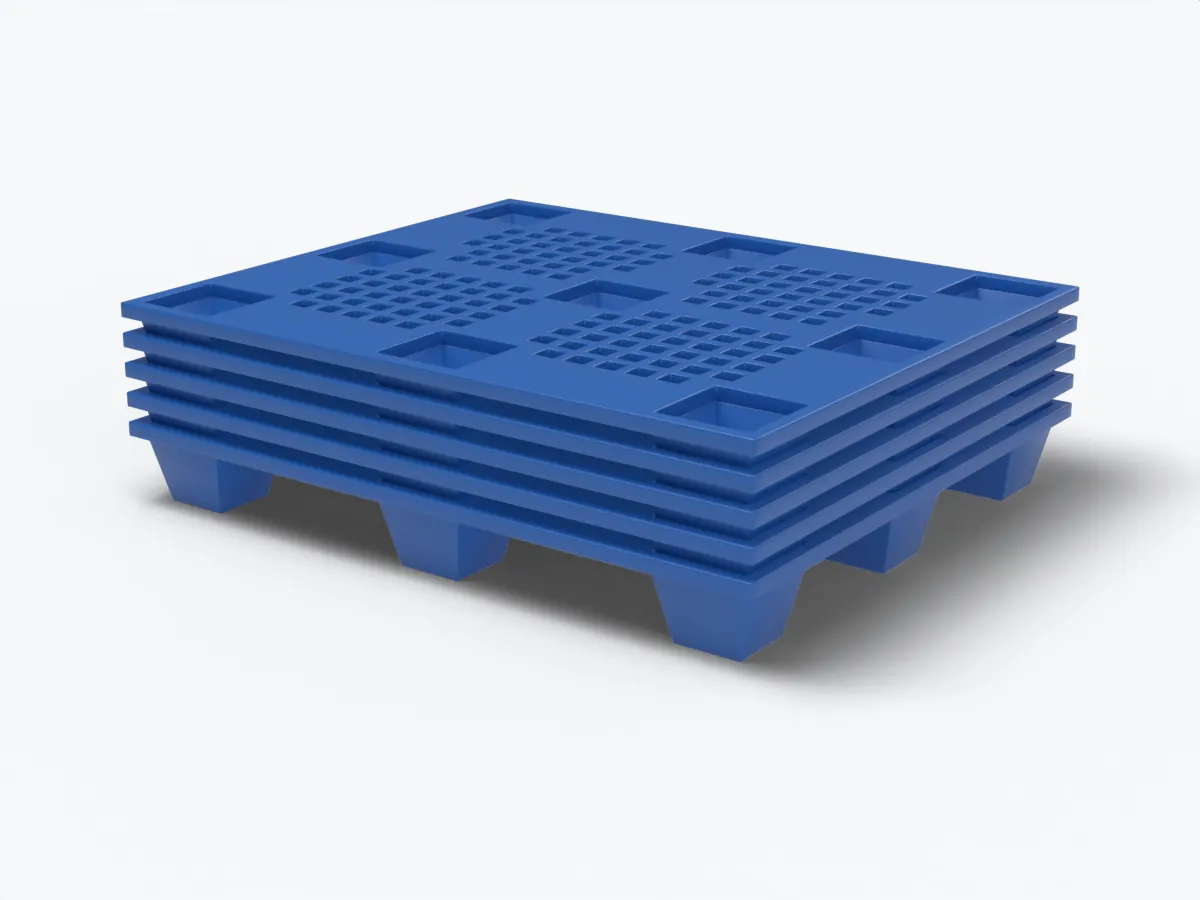
A nestable changes the sum. The first pallet takes its full height and each one nested on it adds only its nest step, the small rise from one pallet to the next. The stack count is one plus the room left above the first pallet divided by the nest step. A small nest step is what lets nestables ship by the thousand.
- Non-nesting: pallets per stack = inside height / pallet height
- Nestable: pallets per stack = 1 + (inside height - pallet height) / nest step
- Trailer total = pallets per stack x floor positions
- Round each step down, then leave room for loading
The one published example
Rehrig Pacific publishes 1,200 pallets per 53-foot trailer for its heavy-duty nestable 40x48, a PP copolymer pallet measuring 48.25 x 40.25 x 6.5 in and weighing 28.5 lb.
Spread over 30 floor positions, 1,200 pallets is 40 to a stack. Spread over 26, it would be about 46. The maker sets the real layout; the division just shows why a nestable count runs into four figures while the non-nesting case above stops near 500.
By weight, 1,200 pallets at 28.5 lb is 34,200 lb, under a typical van payload, so this load fills by space first.
When weight, not space, sets the count
Heavier pallets and loaded pallets can reach the weight limit before the floor is full. Federal rules cap most trucks on the Interstate at 80,000 lb gross, and the tractor and trailer take part of that, so the payload left is set by the carrier's equipment.
Thirty loaded pallets at 1,500 lb each is 45,000 lb of goods, which may be over the legal payload once the truck is weighed. Heavy-duty and structural foam pallets also weigh more empty, so a full trailer of them can weigh out sooner than a trailer of light nestables.
Ask the carrier for the legal payload on the equipment you are booking, then work the count both ways: by space and by weight. The smaller answer is the real one.
Containers for export
A container is narrower than a van. At about 92 in inside, two 48x40 pallets cannot both sit with the 48-in side across, so loaders mix orientations: one column with 48 in across and one with 40 in across, 88 in in all.
In a 20-foot box, 232 in divided by 40 gives 5 in the first column and 232 divided by 48 gives 4 in the second: 9 positions. In a 40-foot box, 474 divided by 40 is 11 and 474 divided by 48 is 9: 20 positions. Square 1165x1165 pallets, about 45.9 in a side, sit two across in roughly 91.7 in, close to the full width, so confirm the fit with your forwarder before you count on it.
Reefers, flatbeds, loading and quoting
Refrigerated trailers lose some inside width and height to their insulated walls and floor ducts, so a count worked for a dry van can come up short in a reefer. Measure the actual box, or ask the carrier, before promising a frozen-food customer a full position count.
Flatbeds and curtain-siders carry pallets too, but loose empties on an open deck need tarps, edge protectors and straps to stop wind lifting the top units. Most plastic pallet freight therefore moves in closed vans.
Inside the van, tall columns of empties should be banded or shrink-wrapped, butted tight against each other and held with load bars or straps at the rear. Hard braking and cornering will otherwise topple a light stack. Tell the receiver whether the trailer is floor-loaded or on slip sheets, and whether they need a liftgate, a dock leveler or a live unload appointment.
Counts are per model, so we quote them per model. Send the footprint, type, deck, heaviest load and whether it is racked, the quantity and the delivery ZIP. We reply by email with models that meet it, how many go on a 53-foot van, and a delivered price. Orders short of a truckload ship LTL as banded or wrapped stacks. Mention dock restrictions, such as residential access, a short-trailer limit or no forklift on site, so the carrier sends suitable equipment.
Questions buyers ask
How many 48x40 pallets fit on a 53-foot trailer floor?
About 30 single-tier positions with the pallets turned, 40-in side along the trailer, or 26 loaded straight. Empty pallets stack on each position, so totals run far higher.
How many nestable plastic pallets fit on a truck?
It depends on each model's nest step and height. One published heavy-duty nestable 40x48 ships 1,200 per 53-foot trailer.
What is a nest step?
The height each extra pallet adds to a nested stack. A smaller nest step means more pallets per stack and per trailer.
Can a trailer of pallets be too heavy?
Yes. Loaded or heavy-duty pallets can hit the legal payload before the floor fills, and state weigh station scales will catch an overweight van. Work out space and weight separately.
Sources
- USDA APHIS: wood packaging material and its alternatives
- Cabka: plastic pallets for export and ISPM 15
- Rehrig Pacific: 40 x 48 heavy duty nestable pallet sheet
Last reviewed November 8, 2026.