05 Guide
Nestable vs rackable pallets
A nestable pallet stands on legs that drop into the pallet below when empty, so it saves trailer and floor space, but most nestables are not rack-rated; a rackable pallet sits on runners and carries a published racked load across two beams. Stackable pallets sit between them. Send your load and racking for a quote on the right type.
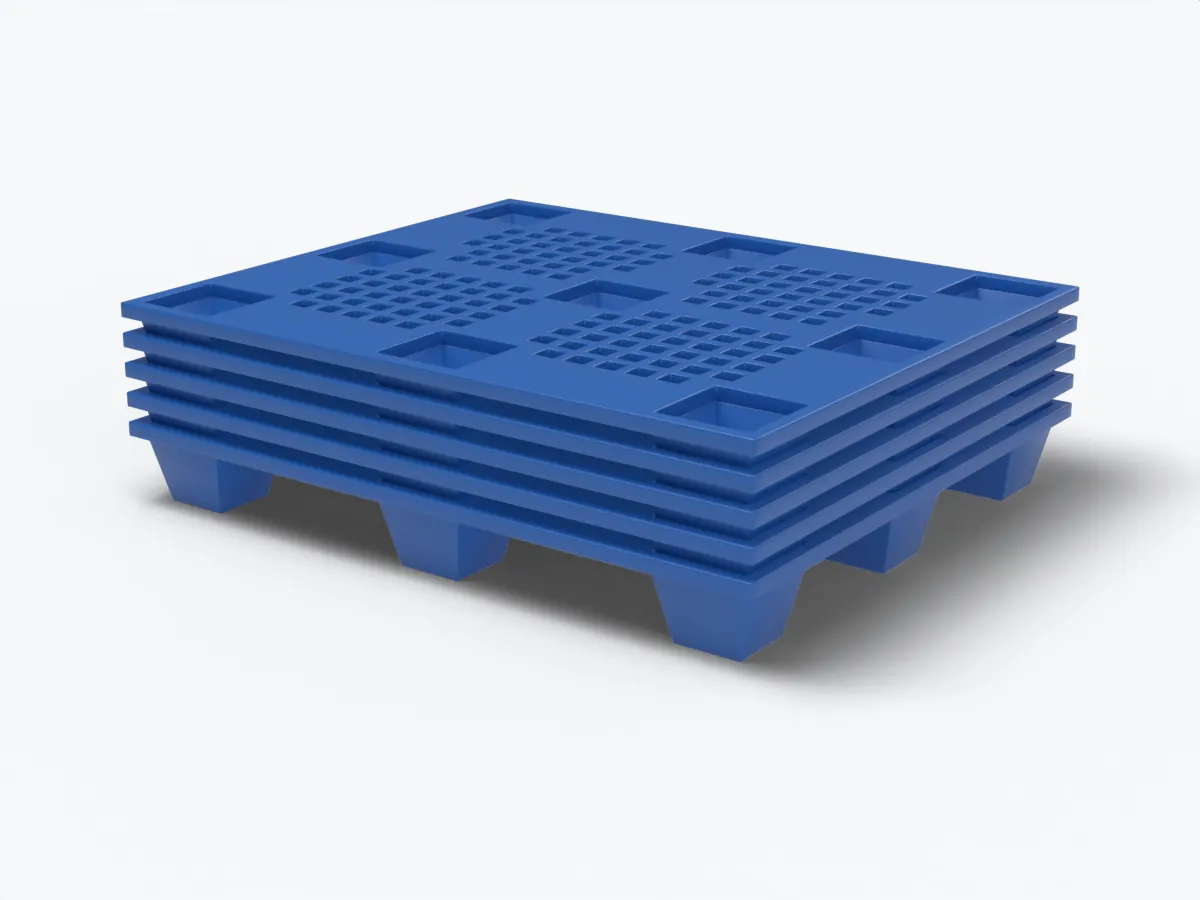
Legs or runners: the part that decides
Turn the two pallets over and the difference is obvious. A nestable pallet has a deck with legs, usually nine of them in a three-by-three grid, and nothing joining the legs underneath. A rackable pallet has the same kind of deck, but its legs are tied together by runners, the bottom boards that give it a flat base.
Those runners do two jobs. They spread the load across a rack beam or a conveyor, and they stiffen the whole pallet so the deck can bridge an open span. Without runners, a nestable's legs would sit unevenly on beams and the deck would carry the full span alone.
The legs of a nestable are tapered and open at the top. With no load on the deck, one pallet's legs slide down into the pockets of the pallet beneath, and the stack grows only by a small step per pallet instead of the full pallet height.
| Feature | Nestable | Stackable | Rackable |
|---|---|---|---|
| Base | Legs only | Legs on three runners | Legs on a perimeter base or three or more runners, often reinforced |
| Empty stack | Nests, a fraction of the height | Stacks at full height | Stacks at full height |
| Loaded stacking | Limited; nine legs press into the load below | Built for loaded block stacking | Stacks loaded, if the static figure allows |
| Racked load | Usually not rated | Not rated unless the sheet says so | Published racked figure |
| Conveyor | Legs can drop between rollers | Runners ride rollers in one direction | Runners ride rollers |
| Weight | Lightest | Middle | Heaviest |
| Typical job | One-way, export, floor, return freight | Floor storage, block stacks | Selective rack, AS/RS, flow lanes |
What a nestable is good at
Space is the reason to buy nestable. Empty pallets coming back from a customer, or new pallets shipping in from a maker, take far less trailer height nested than stacked. The Rehrig Pacific heavy-duty nestable 40x48 is sold at 1,200 pallets per 53-foot trailer, a count a stack of runner pallets cannot get close to.
Nestables are also the lightest plastic pallets for their footprint, which helps on export and one-way loads where freight weight is paid but the pallet never returns. Full four-way entry for forks and pallet jacks is standard, since there are no runners in the way.
Heavy-duty does not mean rackable. That same Rehrig model is rated 10,000 lb static and 3,500 lb dynamic, and its published numbers carry no racked figure. Strong on the floor and on forks is a different claim from strong across a rack opening.
What a rackable is good at
A rackable pallet is designed and tested to span two beams. Its runners sit on the beams, and the deck, base and any reinforcement work together so the loaded pallet stays within the maker's deflection limit for as long as it sits there.
Some rackable models add steel or other reinforcing members inside the deck or runners to lift the racked figure. The sheet will say so, and it will give the racked load for a stated span direction and load pattern.
Runners also suit automation. Roller conveyors, chain conveyors and automated storage and retrieval systems want a continuous flat base, and a nestable's legs can catch or drop between rollers.
The cost is space and weight. A rackable does not nest, so empties stack at full height, and it is heavier than a nestable of the same footprint. Check the entry too: a full perimeter base can limit pallet jack entry to some sides.
The stackable middle ground
A stackable pallet usually has three runners, parallel to one side, under a deck with legs. That base lets loaded pallets block-stack on top of each other on the floor without the legs of one punching into the load below, and it gives a flat surface for conveyors running in the runner direction.
Stackables do not nest, and most are not rack-rated. They suit warehouses that store loads in floor stacks, three or four high, rather than in racks. If you need to rack even some of the time, ask for a model with a published racked figure instead.
Choosing by job
Ask where the loaded pallet spends its life and how the empty one gets back. Those two answers pick the type in most cases.
- Loads go out and the pallet never comes back: nestable
- Empties return on a truck and space on the return trip is paid for: nestable
- Loads sit on the floor in block stacks: stackable
- Loads go into selective rack, push-back or flow lanes: rackable, on a published racked figure
- Loads run on roller conveyors or an AS/RS: rackable or stackable, depending on conveyor direction
- Washdown room with floor storage only: nestable or stackable with a solid deck
- Mixed use in one plant: two fleets, sized by the rack positions you need
Storing empties between trips
Empty pallets take room nobody budgets for. A nested column of plastic pallets occupies one footprint of floor while holding dozens of units, so a bakery or dairy that receives pallets back each morning can park a day's returns beside a dock door instead of across half an aisle.
Runner pallets stored empty need more height and more floor. Plan their stacks around ceiling clearance, sprinkler heads and the reach of the lift truck, and keep columns straight so they do not lean when a driver pulls the top unit.
Outdoors, any lightweight stack can shift in strong wind. Band or wrap tall columns of nestables kept in a trailer lot, and keep plastic away from heaters, exhausts and hot dock plates, which can soften or distort a leg.
Automotive parts suppliers, beverage bottlers and pharmaceutical distributors often run both kinds: rackable units inside the building and nestables for outbound customer freight. Keep the two fleets apart, ideally in different colors, so a nestable never ends up on a beam by mistake.
Getting a quote on the right type
You do not have to name the type. Send the footprint, the deck you need, the heaviest load, whether and how it will be racked, the quantity and the delivery ZIP through the quote form. We reply by email with the nestable, stackable or rackable models, or used grades, that meet it, and a delivered price.
For used pallets the same rule holds. A used nestable is a floor and freight pallet. A used rackable can go back in a rack only if its model was rack-rated and the pallet is Grade A: whole deck, straight runners, no repairs.
Questions buyers ask
Can nestable plastic pallets go in a rack?
Most cannot. Nestables have legs and no runners, so they have nothing to sit on beams with, and most carry no racked rating. Use one only if its sheet gives a racked figure.
What is the difference between stackable and rackable pallets?
Both have runners. A stackable is built for loaded block stacking on the floor; a rackable is tested to span rack beams and carries a published racked load.
Why do nestable pallets save so much trailer space?
Empty, each pallet's legs drop into the one below, so the stack rises by a small step per pallet rather than the full pallet height.
Are rackable pallets heavier?
Yes. The runners and any reinforcement add weight, so a rackable weighs more than a nestable of the same footprint.
Do nestable pallets cost less than rackable ones?
Typically yes, because they use less resin and have no runners or reinforcement. The saving shrinks quickly if a cheaper nestable gets misused in racking and fails.
Sources
- Cabka: plastic pallets for export and ISPM 15
- Rehrig Pacific: 40 x 48 heavy duty nestable pallet sheet
Last reviewed November 8, 2026.