01 Catalog line
Rackable plastic pallets
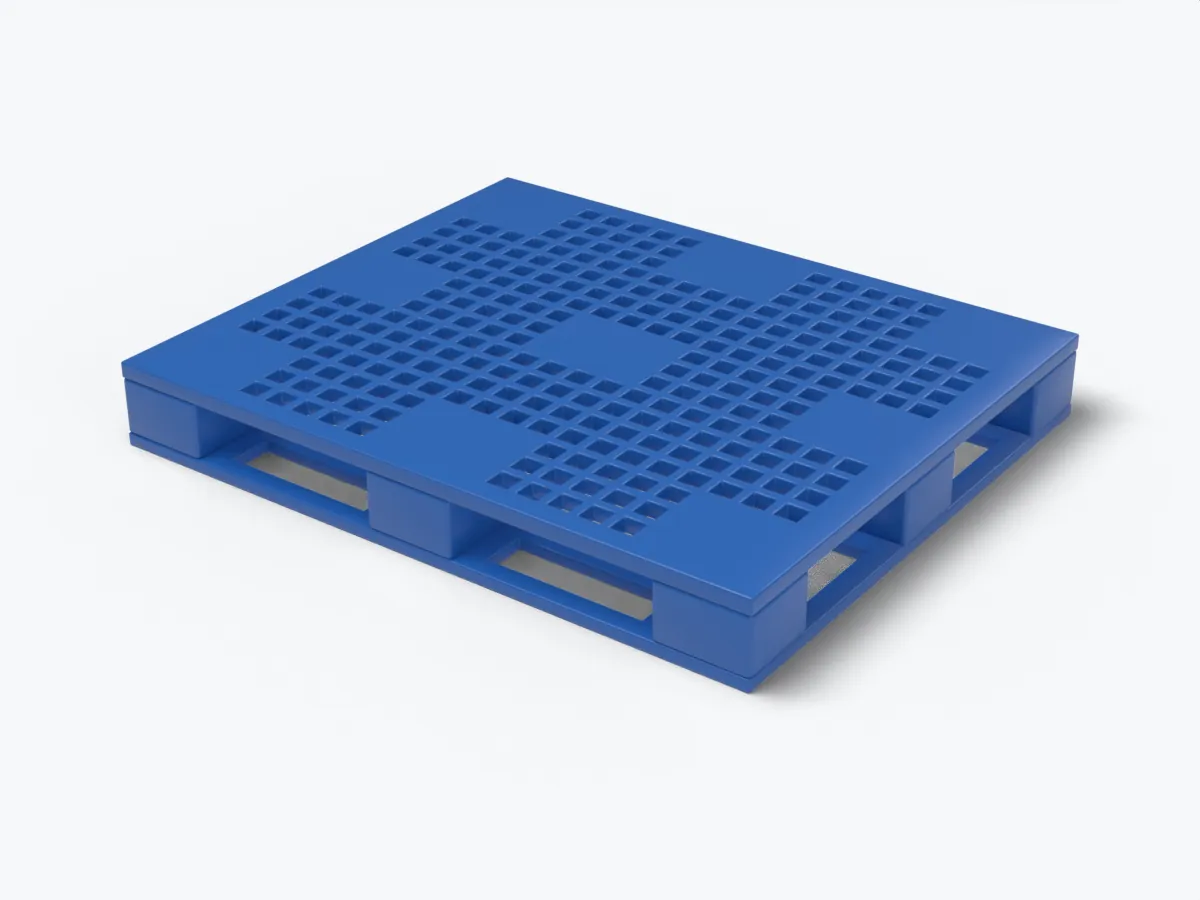
Rackable plastic pallets sit on runners or a full perimeter base, often with steel or composite reinforcement, and carry a racked load on the maker's sheet for spanning two beams with nothing underneath. Tell us your beam span, footprint and heaviest load, and we'll quote rackable models rated for that setup.
- Dynamic load
- Published by the maker; confirm it covers the load moving on forks
- Static load
- The highest figure; it says nothing about how the pallet racks
- Racked load
- The deciding figure; ask for it at your beam span and orientation
What makes a plastic pallet rackable
A pallet is rackable when its maker publishes a racked load for it, and for no other reason. Looking sturdy is not a rating. The racked load is the weight the pallet carries while bridging two beams with open air below the deck, and it is usually the lowest of the three numbers on the sheet.
To earn that number, rackable models have a bottom. Some use three runners, one under each row of blocks, running the length of the pallet. Others use a perimeter base: a closed frame around the outside edge with a cross member, which spreads the load evenly onto the beams and onto a loaded pallet below it.
Reinforcement does much of the rest. Many rack-rated models have steel tubes or channels, or fiberglass and composite rods, molded into the deck or runners to stop the span from sagging. Structural foam and thick-walled injection molding are common for this work, and some twin-sheet thermoformed pallets are rack-rated too.
The rack decides the rating you need
A racked load is only meaningful with the conditions it was measured under. The two that change it most are the clear span between beams and which side of the pallet bridges that span. A 48x40 spanning its 40-inch side behaves differently from one spanning its 48-inch side, so makers state the orientation with the figure.
Plastic also creeps. A load that a pallet holds for an hour can sag it further over weeks in a warm building, so ratings are given at a stated temperature and assume a uniformly distributed load. A few heavy items concentrated in the middle of the span load the deck harder than the same weight spread across it.
| Rack setup | What the pallet does | Ask for |
|---|---|---|
| Selective beam rack, open | Spans two beams front to back | Racked load at your clear span and orientation |
| Beam rack with wire decking | Rests on the deck between beams | Racked load, plus whether decking changes the case |
| Drive-in or drive-through | Hangs on two side rails by its edges | Edge-racked load on the rail width you have |
| Pallet flow or push-back | Rolls on rollers or carts on its runners | Approval for flow use and runner direction |
| AS/RS and conveyors | Rides on chains or rollers, then spans a slot | Base flatness, runner layout and racked load |
Rackable spec table
| Feature | Three-runner base | Perimeter base |
|---|---|---|
| Bottom | Three runners joining the blocks | Closed frame around the edge, with cross members |
| Fork entry | Four-way | Four-way |
| Hand jack entry | From the two ends the runners point to | Limited; check the drawing for jack openings |
| Reinforcement | Steel or composite in deck or runners on many models | Steel or composite on many models |
| Deck | Solid or open grid | Solid or open grid |
| Resin | HDPE or PP | HDPE or PP |
| Loaded stacking | Usually allowed | Usually allowed, and spreads load evenly |
| Conveyor use | Good along the runners | Good in both directions |
Where rackable pallets earn their cost
The trade-off is space and weight. A rackable pallet can't nest, so every empty keeps its full height, and the bottom and reinforcement add weight compared with a nestable of the same footprint. For one-way freight or a loop where empties ride back in bulk, a nestable or a light export model costs less to own and to move.
- Selective racking in distribution centers and plants, where loaded pallets sit on beams for days or weeks
- Automated storage and conveyor lines that need a flat, consistent bottom pallet after pallet
- Closed loops in manufacturing where the same pallet goes into racks at both ends
- Loaded floor stacking, since runners spread the weight onto the pallet below
Footprints for racking
Most rack-rated molds are 48x40, matching the beam depths most US racking is laid out for. 48x45 is the automotive footprint, 42x42 and 48x48 serve paint and drum work, and 1200x1000 suits racking built to European and export layouts. Every footprint needs its own racked figure, because the span changes with the size.
Push-back carts and pallet flow lanes are usually laid out for one footprint and one runner direction, so a mixed fleet with different bases can hang up in them.
Inspecting pallets in rack service
Rack placards on the uprights state the beam capacity per level. The pallet's racked load is a separate limit, and whichever is lower governs what goes on that level. Neither number replaces the other.
Racked pallets wear in predictable places, so check them on a schedule. Look for a deck that stays bowed when the pallet is empty, cracks at the runner joints or corner blocks, and exposed steel where a fork tine has cut through. A pallet that stays bowed should come out of rack duty and go to floor use, where its static rating still serves. Ask the maker what deflection to expect at your load, so the team knows what normal sag looks like.
What to put in a rackable quote request
Measure the clear distance between the inside faces of the beams and note which side of the pallet will bridge it. Give the heaviest load per pallet and whether it is spread evenly or sits in a few heavy spots. Tell us the rack type, the room temperature if it is a cooler or a hot mezzanine, and whether the pallets also run on conveyors. Add footprint, quantity and delivery ZIP. The reply comes by email and names models whose published racked load covers your figure at your span, with a delivered price.
Questions buyers ask
Why is the racked load lower than the static load?
On the floor the whole base is supported. On two beams the middle of the pallet hangs free, so the deck and runners carry the load by bending, which they can do with less weight.
Does a rackable plastic pallet need steel reinforcement?
Not always. Some models reach a useful racked load from structural foam or deep ribbing alone, while higher racked ratings usually come from steel or composite inserts.
Can I use a rackable pallet in a drive-in rack?
Only if the maker rates it for edge racking on side rails. That is a different case from beam racking, and the figure is often lower.
How do I measure beam span for a racked rating?
Measure the clear gap between the inside faces of the front and rear beams, and note which pallet side bridges it. Give both to the maker or to us with the quote request.
Can rackable plastic pallets be used in freezer racking?
Yes, with a model whose resin stays tough when cold, usually HDPE or PP copolymer. Ask for the racked figure at freezer temperature, because stiffness and impact behavior both shift in the cold.
Sources
Last reviewed November 8, 2026.